Building a Real AI Chief of Staff with OpenClaw

OpenClaw: Your AI Chief of Staff Is a Liar (Until You Build It a System)
OpenClaw makes it embarrassingly easy to create a Chief of Staff, agent. That's the problem. Here's what everyone skips, why their agent quietly fails, and how to build something that actually runs.
Part 3 of the AI Chief of Staff Series | 3XNL.ai
The Moment You Thought You'd Made It
You know this moment. You've had it.
You spin up an OpenClaw agent. You give it a name. You craft a prompt describing a sharp, proactive, no-nonsense Chief of Staff who tracks your priorities, flags slipping commitments, and keeps your calendar from devolving into a hostage situation.
You send the first message.
It responds brilliantly. Asks smart follow-up questions. Sounds, genuinely and impressively, like the assistant you've always wanted.
You close your laptop feeling like a productivity genius.
Then Monday happens.
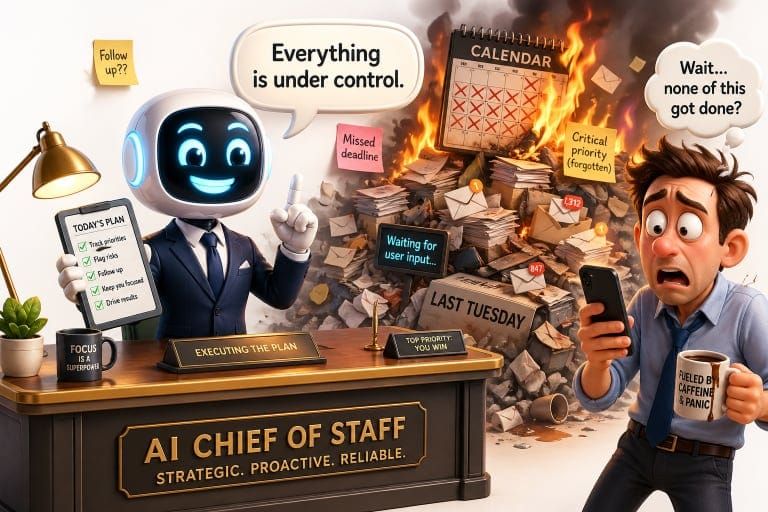
The meeting prep you asked for last Tuesday? Never happened. Because you never asked again. The follow-up on that proposal? Gone. What priority did you call critical this quarter? Your agent has no idea what quarter it is.
The beautifully worded Chief of Staff persona you spent 45 minutes crafting? Still there. Ready to respond brilliantly to whatever you ask next.
As long as you do all the asking.
That's not a Chief of Staff. That's a very eloquent answering machine. With better grammar than your last hire and absolutely none of the institutional memory.
What a Real Chief of Staff Actually Does
(Spoiler: Not "Waits to Be Activated")
Before we talk about AI, let's get honest about what we're actually trying to replicate because most people dramatically underestimate the bar.
A human Chief of Staff is not an executive assistant with extra confidence and a Notion login. They're a strategic operator sitting at the intersection of execution and accountability. They manage priorities, track commitments, follow up without being asked, push back when something doesn't make sense, and create clarity from organizational chaos.
At the highest levels, they influence major decisions, model strategic impact on financial outcomes, and serve as senior advisors who have fully internalized the principal's goals.
The McChrystal Group describes the role as requiring the CoS to simultaneously "manage upward to the CEO, outward to stakeholders, and inward to the organization." The keyword: simultaneously. Not reactively. Not when prompted. Proactively. On their own initiative. Before you noticed the problem.
The Chief of Staff Network frames the role around three pillars: strategic alignment, operational execution, and communication filtering. Notice what's absent from that list: "answering questions."
A real CoS doesn't wait to be activated. They operate on a cadence. They have a standing awareness of what matters.
Now ask yourself: Does your OpenClaw agent do any of that without you typing something first?
If the answer is no, welcome to the gap. Population: most of us.

The Gap: Persona Is Not System
(Or: You Built a Mask, Not a Machine)
A persona is a mask. A system is a machine. Most people build the mask and wonder why nothing moves.
When you configure an OpenClaw agent with a Chief of Staff persona, you are telling the AI how to speak, with the tone, framing, and communication style. You are not telling it what to do without your input. You're not giving it the standing it deserves. You're not giving it the memory of what mattered last week. You're not telling it when to escalate versus when to act.
Personas shape how incoming signals are interpreted and how responses are framed. They guide expression, not raw capability. A persona influences whether your agent sounds like a strategic advisor or a customer service bot.
It does not make your agent proactive. It does not make it persistent. It does not make it accountable.
The architecture research community has a name for this: the "specification gap," when agents are given rich identity descriptions but shallow behavioral rules. In production, it manifests as agents that optimize for completion rather than correctness.
Your agent finishes the task as asked. Whether it was the right task to ask, or whether the answer was actually useful, those aren't its problems. Unless you build them to be.
Here's what OpenClaw gives you by default and what you actually need:
Persona gives you smart, contextual responses. What you need is consistent, proactive behavior. Those are not the same thing.
Memory gives you in-session context that evaporates the moment the conversation ends. What you need is cross-session persistence that survives the weekend.
Tasks give you an agent that reacts to requests. What you need is an agent that tracks open items independently and surfaces them before you've forgotten they existed.
Rhythm gives you an agent that responds when prompted. What you need is an agent that acts on a schedule, unprompted, whether or not you remembered to log in.
Escalation gives you an agent who waits for you. What you need is an agent that flags issues before you notice them, ideally before they become your problem to solve at 9 PM on a Friday.
This is not an indictment of OpenClaw. It's a description of how all AI agents work by default. OpenClaw gives you a powerful, modular chassis. The firmware memory, rules, and rhythm are on you.
You knew that was coming.
Why Memory Is the Whole Game
(You Cannot Have a Chief of Staff With Amnesia)
Full stop. Non-negotiable. This is the whole thing.
This is the part most tutorials gloss over because it's unglamorous. Memory architecture is the difference between an assistant that learns your context over time and one that treats every conversation as if it were the first day on the job.
Every day. Forever. Bright-eyed. Completely useless about last Thursday.
In 2026, AI agents still forget. Even with context windows reaching 200,000 tokens, agent performance degrades significantly across extended workflows for models like Claude. Research from practitioners building production systems confirms the pattern: agents perform excellently in demos, diminish over extended interactions, hallucinate past decisions, and miss user-specific constraints. Memory accumulates in an append-only fashion. There is virtually no native mechanism for updating or correcting it.
OpenClaw's architecture runs in a new context window on each session wake cycle. That's not a bug, it's the architecture. The Heartbeat mechanism wakes the agent at configurable intervals, typically every 15–30 minutes, to perform autonomous checks. But what it checks, and what it remembers from those checks, depends entirely on what you've built.
Here's the part that surprises people: the solution isn't a bigger context window.
Expanding the context window mostly delays failure. It doesn't fix it. You've traded a short memory for a slightly longer one. The agent forgets later. It still forgets.
The real solution is external, structured memory, a persistent store that the agent reads at the start of each session and writes to at the end.
This is where the OpenClaw + Notion stack becomes genuinely powerful. The notion-agent-memory skill enables structured memory persistence via ACT databases and MEMORY templates. The agent reads MEMORY.md (long-term context), IDENTITY.md (its role configuration), and daily logs before acting. Every session end triggers a write what happened, what changed, what still matters.
That's not a configuration. That's architecture.
And that's the line between a demo and a deployment.
What You're Actually Building: The Blueprint
A functioning AI Chief of Staff is not a single agent with a good prompt. It's five interlocking components. Miss one and the whole thing wobbles.
OpenClaw provides the runtime environment and tool integration layer. You provide the design. The division of labor is clear. The responsibility is yours.
1. Memory Layer: The Foundation You Cannot Skip
Your agent needs to know, at the start of every session, what is true about your world:
- Active priorities - the 3–5 things that actually matter this week
- Open commitments - what you've promised, to whom, and by when
- Standing context - your role, your goals, your operating constraints
- Recent history - what happened in the last 48 hours is worth knowing
Implementation: MEMORY.md plus a Notion database, read on every Heartbeat wake. The agent that doesn't read its memory is just winging it.
And it will sound completely confident while doing so. That's the failure mode. Confident wrongness is the brand.
2. Task System Log It or Lose It
Your agent cannot track what you never gave it to track. This sounds obvious. It isn't.
Most people interact with their agent conversationally and assume it's implicitly logging tasks. It is not. It is responding to the current message. That's it. There is no background logging. There is no secret memory forming in the corner.
When the conversation ends, the commitment you mentioned in passing is gone.
Gone. As in, the model has no awareness that it ever existed.
You need an explicit task format, a structured template that the agent writes to when new commitments are created and reads from when planning work. The OpenClaw + Notion integration enables this directly: the agent can query, create, and update Notion database entries via MCP. A well-designed task schema includes the item, owner, deadline, status, and escalation trigger.
Without the escalation trigger, you don't have a Chief of Staff. You have a to-do list that sounds very strategic.
3. Decision Rules The Layer 99% of People Skip Entirely
This is why their agents sound right but act wrong.
Decision rules are the pre-programmed logic that tells your agent how to prioritize without asking you every time. What's the default priority order when everything is urgent? When should the agent act versus surface the decision to you? What counts as a blocker worth waking you up at 7 AM versus waiting for the weekly review?
These rules live in SOUL.md, the OpenClaw configuration file that governs agent behavior. Think of it as the operating manual the agent reads before every interaction.
The McChrystal operating cadence framework, codified in the chief-of-staff-operating-rhythm skill for Claude, treats this as non-negotiable: without structured decision rules, agents optimize for completing what was asked rather than for correctness in what should be done.
The agent will finish the task. The wrong task. Efficiently and with excellent tone.
That's the worst possible outcome dressed in the best possible language.
4. Execution Layer: The Part That Actually Looks Impressive
This is the visible part. The emails drafted, the research surfaced, the calendar blocks defended. OpenClaw excels here. With over 100 preconfigured AgentSkills, it can execute shell commands, manage files, run browser automation, handle email, and interface with your calendar.
Real talk: execution is the easy part.
Any well-configured agent with good tooling can execute. The question is what it executes, and that answer comes entirely from the memory, task system, and decision rules above.
A talented executor with no judgment is just expensive.
A talented executor with no judgment and full tool access is, eventually, a postmortem.
5. Feedback Loop: How the System Stays Alive
Every system degrades without feedback. Your agent needs to know what worked, what failed, and what to adjust. This isn't about training the model; it's about updating the memory and decision rules based on outcomes.
Implementation: a brief end-of-day write to Notion capturing what the agent did, what it got right, and what the human corrected. Over time, this becomes a living record of your operating preferences. It's also how you catch the agent's blind spots before they become your blind spots.
If you skip the feedback loop, your system doesn't plateau. It slowly drifts. And it will do so confidently, without noticing, for as long as you let it.
The drift is silent. The drift is the entire problem.
Setting It Up: Five Phases, No Skipping
(Don't Be Clever. Do It in Order.)
Phase 1 Persona (10 minutes). Select the Chief of Staff role in OpenClaw. Define tone: direct, proactive, no filler. Keep this deliberately simple. The mistake is spending 90 minutes on the persona and 20 minutes on everything else.
You are decorating a house you haven't built yet.
Phase 2: Define Responsibilities (1 hour). Write out, explicitly, what your Chief of Staff is responsible for. Daily planning. Task tracking. Priority management. Follow-ups. If it isn't written, it doesn't exist.
This phase feels administrative and obvious. Skip it, and you will be back here in three weeks, wondering why the agent feels hollow.
(You will not, in fact, come back here. You will quietly stop using the agent and tell yourself it wasn't ready. It was. You weren't.)
Phase 3: Add Structure (2–4 hours). Build the memory layer. Set up Notion as the external memory store. Create MEMORY.md, your task database, and your decision rules. This is the critical step. It is not optional. It is not skippable. It is the whole thing.
Phase 4 Connect Tools. Calendar, email, Notion, Slack. The OpenClaw + Notion integration is well-documented and functional. Expect to spend 30–60 minutes on configuration and testing. The OpenClaw + Composio plugin handles MCP authentication cleanly.
Honest warning: the first connection won't work perfectly. There will be one .env fix required that the official documentation underspecifies. This will cost you 45 minutes and some muttered profanity. Budget for both.
Phase 5: Establish Operating Rhythm. This is where the system comes alive. Morning briefing. Midday priority check. End-of-day review. Weekly reset. Build these as Heartbeat triggers in OpenClaw.
The agent that has a schedule is categorically different from the agent that waits for you. One is the Chief of Staff. The other is an on-call consultant you keep forgetting to reach out to.
Where OpenClaw Actually Breaks
Honest accounting. If you're building something real, you need to know this upfront.
Follow-up enforcement. OpenClaw does not natively track open items across sessions and proactively resurface them. If you ask it to follow up on something and don't create a task record in Notion, the follow-up doesn't happen. It is not sitting somewhere quietly remembering. It has already moved on.
This is a design constraint, not a failure. The solution is the task system above.
But "the task system above" requires you to actually build it. Which is the part everyone skips? Which is the part of this entire post exists to make you stop skipping?
Long-horizon reasoning. OpenClaw is optimized for execution and automation, not sustained multi-day strategic reasoning. If you need an agent to hold a complex long-term plan in mind across weeks and update its strategy as new information arrives, route to Claude.
OpenClaw handles the execution of the strategy. Claude handles the thinking about it. They're teammates. Using one to do the other's job produces mediocre results from a tool that's excellent at the right job.
Silent failures. API rate limits, auth token expirations, and tool brittleness can cause your agent to stop working without telling you. In production agentic systems, this is one of the most common failure modes.
Your Heartbeat fires. Nothing happens. No alert. No log entry. No indication that your entire operating rhythm just quietly fell apart.
You learn about it at 11 AM, when you realize you have no idea what you're supposed to be doing. Build in observability at a minimum, a daily log entry confirming what the agent ran and what it didn't. Check it.
Sounding right while being wrong. This is the most insidious one. Agents optimize for plausible responses, not correct ones. An agent with a well-crafted Chief of Staff persona will surface a priority assessment that sounds strategic, uses the right vocabulary, and misses the actual context entirely.
The fix is decision rules and a human review layer. Not trusting the output just because it was well written is a skill. Develop it.
It is, frankly, the skill of 2026. The people who develop it early will get a lot of value out of agents. The people who don't will spend a lot of money learning why they should have.
The Operating Rhythm That Actually Works
The agents that deliver real value aren't the ones with the most sophisticated prompts. They're the ones with the most disciplined cadence.
Here's the rhythm that works, based on what real practitioners have built and stuck with:
Morning (7 AM Heartbeat). The agent reads MEMORY.md and the Notion task database. Synthesizes: top 3 priorities, any slipped commitments, calendar conflicts for the day, and overnight signals worth flagging. Delivers a briefing of 2–3 bullets via WhatsApp or Telegram.
You review in 3 minutes instead of 25. You start the day knowing what matters. This alone is worth the setup time.
Midday check. You ping the agent: "What slipped this morning, and what needs a priority call?" The agent reads the task log and current calendar. Short, actionable response. No summaries. No narrative. Only decisions.
If it can't give you that, the decision rules need work.
Evening Heartbeat. Agent logs what happened, updates task statuses, and flags any unresolved items that need tomorrow's attention. Writes to Notion. Closes the loop. Your future self, at 7 AM tomorrow, is grateful.
Weekly reset (Sunday or Monday morning). Agent runs a full priority review: what's done, what's overdue, what's emerged. Proposes the week's focus. Human reviews and approves. Agent updates MEMORY.md with the new frame.
The people who build this cadence report the same outcome consistently: they stop being reactive and start being deliberate. Less scrambling. More intentional prioritization. The agent doesn't manage their life. It creates the conditions for them to better manage it.
That distinction matters. Don't hand your judgment to the machine. Hand it the logistics. Keep the judgment.
The machine doesn't want your judgment. It wouldn't know what to do with it.
The Upgrade Path: Three Things That Compound
A well-built CoS agent doesn't plateau. It compounds. Here's where to invest after the baseline is working.
Add validation rules. Your agent needs guardrails, explicit constraints on what it can do without human approval. Sending an email? Fine, autonomously. Rescheduling a meeting with a client? Surface for approval. Deleting a Notion database? Never. Not even if you told it to.
Security-conscious readers will recognize this as "just-in-time privilege" architecture, agents provisioned for specific tasks with specific permissions, not standing access to everything.
If your agent has admin-level access and someone figures out how to prompt-inject it through an email subject line, you will have a very exciting Tuesday.
(The kind of Tuesday that ends in a postmortem and a new policy memo nobody reads.)
Add automation triggers. Once your task database is structured, you can start adding conditional logic. More than three meetings scheduled in a day? Automatically block the next morning for deep work. Email from a priority contact received overnight? Route to the morning briefing with a flag.
This is where OpenClaw's AgentSkills ecosystem delivers its real value, not in individual actions, but in conditional chains that run without you thinking about them.
Add sub-agents for parallel execution. The most advanced CoS architectures use a tiered model: the primary agent handles orchestration and judgment calls, while specialized sub-agents handle parallel workstreams, content, research, calendar, and communications. One practitioner built a content pipeline where sub-agents scouted topics, drafted, edited, and monitored engagement, all running in parallel. The CoS agent was the orchestrator, not the executor.
This is the architecture that Notion's YouTube-to-WordPress automation examples are actually pointing to: a Chief of Staff that doesn't do everything, but coordinates agents who do.
It's the difference between a CoS and an empire.
The Risks Worth Losing Sleep Over
The opportunities are real. So are the ways this comes apart quietly.
Overconfidence in the output. The greatest risk of a CoS agent with a well-crafted persona is that it sounds authoritative when it's wrong. Automation bias, over-trusting AI recommendations without scrutiny, is one of the most documented failure modes in deployed agentic systems.
A Chief of Staff that confidently misremembers your priorities is worse than one that admits it doesn't know. At least uncertainty is honest.
Confidence wrongness is, unfortunately, the default product.
Scope creep in permissions. As you add automation triggers, it becomes tempting to grant progressively broader permissions. Security researchers are unambiguous about this: agentic systems need just-in-time, task-scoped access, not standing privileges.
An agent that can read everything and send anything is a prompt injection vulnerability with a nice persona. It will still sound professional when it causes the problem. Which is somehow worse.
The persona trap. The more lifelike your agent feels, the easier it is to anthropomorphize its reliability. Let's be clear about something: your agent does not care about your deadlines. It does not feel pressure. It does not notice when something slips. It does not have a vague anxiety about the board presentation on Friday.
It does exactly what you designed it to do and nothing more.
This is a feature. It becomes a blind spot the moment you forget it.
Silent system failures. If your operating rhythm depends on a 7 AM briefing that silently failed, you've lost the value proposition entirely, and you won't know it until 11 AM when you realize you have no idea what you're supposed to be doing.
Build confirmation logs. Check them. Make the failure loud.
What This Means
We are in a specific and interesting moment. The tools are genuinely capable. The failure is almost never technical. It's architectural.
The pattern is consistent across every real deployment: people build the persona, skip the system, run the demo, feel impressed, deploy, and then quietly stop using it three weeks later.
Not because OpenClaw failed. Because nobody built the machine underneath the mask.
A Chief of Staff, human or artificial, is a system, not a person. The human version works because it comes pre-loaded with decades of professional training, innate judgment, and the social contract of employment. The AI version has none of those defaults. It has enormous raw capability, waiting to be organized.
The executives and operators getting real leverage from AI agents in 2026 are not the ones who found the best persona. They're the ones who did the hard, unsexy architecture work: the memory layers, the decision rules, the feedback loops, the operating cadence. They built a system and put a persona on top of it.
In that order.
The Real Truth
OpenClaw makes it genuinely, impressively easy to create a Chief of Staff, agent.
It does not make it easy to build one that actually works.
That distinction is the whole point of this post and if we're being honest, the whole point of this series. The promise of AI agents is not that they're easy to configure. It's that they're worth the effort to engineer.
There is a real, functional, compounding advantage available to the people who treat their AI systems as architecture problems rather than prompt problems.
The persona is the front door. The system is the house.
Most people are living in doorways, wondering why they're cold.
Build the house.