The Great Compression


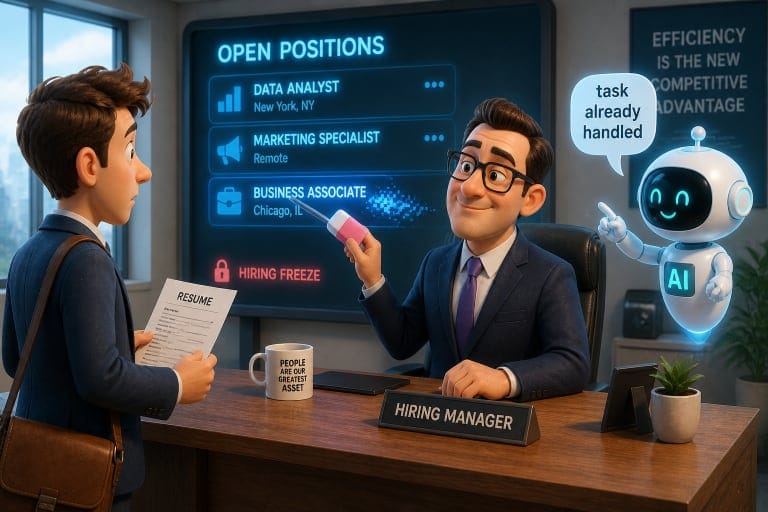
Your job isn't being eliminated. Your replacement just isn't being hired.
Nobody Got Fired. Everyone Just Quietly Stopped Getting Hired.
The AI jobs apocalypse isn't coming. Something quieter, slower, and significantly worse has already arrived.
The robots aren't marching through office lobbies. Nobody's loading pink slips into boxes. Unemployment isn't spiking. GDP is growing. Margins are fat. Dividends are flowing. From the outside, everything looks completely normal.
And yet something is structurally, irreversibly wrong.
Junior employees aren't being fired. They're just not being hired. Open roles aren't being backfilled. Budgets that used to fund teams now fund subscriptions. The change is quiet, methodical, and far more economically dangerous than a dramatic collapse because it's invisible enough to go unaddressed until it isn't.
This is The Great Compression.
It is not coming. It is already here. And the people still waiting for the dramatic version of this story to arrive will miss the actual one.
The Apocalypse You Were Promised Isn't Showing Up
The dominant AI narrative is mostly wrong about the mechanism, and that's the part that should worry you.
The story goes like this: AI is coming for your job. AGI in five years (or two, depending on which tech CEO is currently raising a round). Mass unemployment imminent. Society fractures.
Compelling. Cinematic. Mostly wrong.
Look at the actual numbers. U.S. unemployment is historically stable. GDP is growing. Companies across nearly every sector are reporting stronger operating margins, not collapsed ones. By conventional metrics, the labor market looks fine.
So if AI is the most disruptive technology in human history, why hasn't the economy buckled?
Reality check:
Because the disruption isn't working through destruction. It's working through compression, the quiet, compounding process of reducing the number of people needed to produce the same output.
Same work. Fewer workers. More competition for the seats that remain.
The fear isn't crazy. It's just aimed at the wrong mechanism, which is somehow worse than being wrong about the conclusion.
Why The Doom Story Sells (Follow The Money)
The "AI kills all jobs" narrative dominates because the people loudest about it have a financial interest in you believing it.
Tech companies raising billions need their technology to sound world-historically important. VCs need their portfolio companies to sound transformational. Executives pitching AI-driven efficiency need Wall Street to believe in the magnitude of the savings.
Goldman Sachs has projected that generative AI could displace as many as 300 million jobs globally, a number large enough to dominate board decks, news cycles, and policy conversations.
That number isn't a prediction.
That number is positioning.
There's also a valuation gap at work. Many AI companies have civilization-reshaping expectations baked into their stock prices with relatively modest near-term monetization. The most efficient way to keep those valuations propped up is to keep insisting that what they're building is civilization-reshaping.
Translation:
"We improved some workflows" doesn't justify a $100 billion valuation.
"We're going to eliminate the need for most knowledge workers." does.
Sound familiar?
None of this means AI isn't transformative. It absolutely is. But the shape of the transformation is different from what the loudest voices are describing and getting the shape right is the entire point.
Speed Is The Whole Game
Every previous tech disruption eventually got absorbed by the labor market. This one might too. The "eventually" is what ruins lives.
Technological disruption has always triggered labor-market panic, and history has vindicated the optimists. Eventually.
The Industrial Revolution mechanized physical labor. Computing mechanized calculation. The internet mechanized communication and commerce. Jobs evolved. New industries formed. The economy absorbed the shock.
So why should this time be different?
One word: speed.
- Industrial Revolution: 150 years
- Computing era: 40 years
- Internet era: 20 years
- AI: a single hiring cycle. Sometimes faster.
The economy doesn't break because of the direction of change. It breaks when the rate of change outpaces the institutions designed to manage it.
Education systems take decades to reform. Retraining programs take years to build and scale. Policy is almost always reactive, never anticipatory. When the technology moves faster than any of those systems can track, you get a gap.
People fall into gaps.
The optimists aren't wrong about where this ends. They're just conspicuously quiet about who gets left behind on the way there and how long "the way there" actually takes for real humans in real careers.
That's not optimism. That's selective vision in a tailored suit.
The Jevons Paradox Speech (And Why It Doesn't Save You)
The strongest counterargument to all of this is real, well-supported, and totally inadequate at the level where most people actually live.
Here's the smart objection. In 1865, English economist William Stanley Jevons noticed that as steam engines became more efficient, coal consumption increased rather than decreased. Efficiency unlocked so much new economic activity that total demand exploded.
The pattern has repeated through every wave since:
- Email created more communication, not less
- Spreadsheets created more financial analysis, not less
- Every tool that made work cheaper also created more demand for work
Apollo Global's chief economist, Torsten Slok, recently pointed to AI for the same idea, arguing that as AI makes professional services cheaper, demand expands, and total employment in fields like law, accounting, and consulting could actually grow.
It's not a fringe argument. There's real data behind it. Bureau of Labor Statistics data shows software developer employment grew 17.9% after ChatGPT's launch. New iOS apps are up 50% year-over-year. Demand for AI-enabled output is genuinely expanding.
So the optimists have a point.
Three problems with that point:
1. New demand concentrates at the top.
When AI expands the pie for legal services, the people capturing that expansion are the senior partners leveraging AI, not the junior associates who used to do the first-draft work that's now automated.
2. Jevons' effects take decades.
The historical precedent everyone cites, ATMs creating more bank teller jobs, is more complicated on inspection. ATMs reduced the cost per branch, banks opened more branches, and teller jobs initially grew. But over the long arc, total bank teller employment still declined substantially. The expansion happened at the industry level. The displaced workers weren't automatically the ones rehired.
3. Displaced workers ≠ rehired workers.
The Jevons Paradox tells you that new work will be created. It does not tell you it'll be distributed to the people whose work disappeared. A 52-year-old customer service manager displaced by an AI chatbot doesn't smoothly transition into an AI infrastructure role. The new job exists. It's just not accessible.
The Jevons Paradox describes what happens to industries.The Great Compression describes what happens to people.
Those aren't the same thing. Pretending they are is the oldest economist trick in the book.
Paid subscribers keep the lights on. Free subscribers keep us humble.