Paperclip AI and the Coming Management Crisis

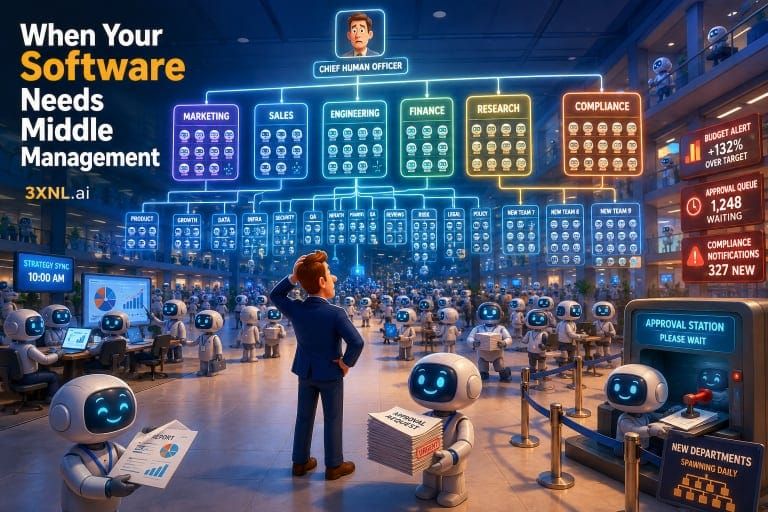
How Paperclip is betting that managing AI agents will look a lot like managing a company, and why it might be right
The New Management Problem
A year ago, the question keeping tech leaders up at night was: Which AI model should we use?
Today, that question feels almost quaint. The new one is harder: How do I manage an entire workforce of AI agents without losing my mind, my budget, or my audit trail?
This shift happened fast. In 2023, the idea of deploying even one autonomous AI agent felt bold. By 2025, enterprises were running dozens. By 2026, Gartner projected that the average Fortune 500 company would be operating more than 150,000 AI agents by 2028 and that 40% of enterprise applications would include task-specific agents by the end of the year. The problem isn't building agents anymore. The problem is that nobody quite knows how to run them at scale without things going sideways.
Enter Paperclip.
What Paperclip Actually Is (And What It Isn't)
Let's be clear about what Paperclip is not. It's not a ChatGPT competitor. It's not a foundation model, a coding assistant, or another AI wrapper. It doesn't generate text, write code, or answer questions.
What Paperclip is is an orchestration platform: a management layer designed to coordinate, govern, and run multiple AI agents simultaneously. Launched as open source in early 2026 under the MIT license, Paperclip lets you deploy and manage AI coding agents, such as OpenClaw, Claude Code, and Codex, from a single web interface, organizing them into something that looks suspiciously like a company.
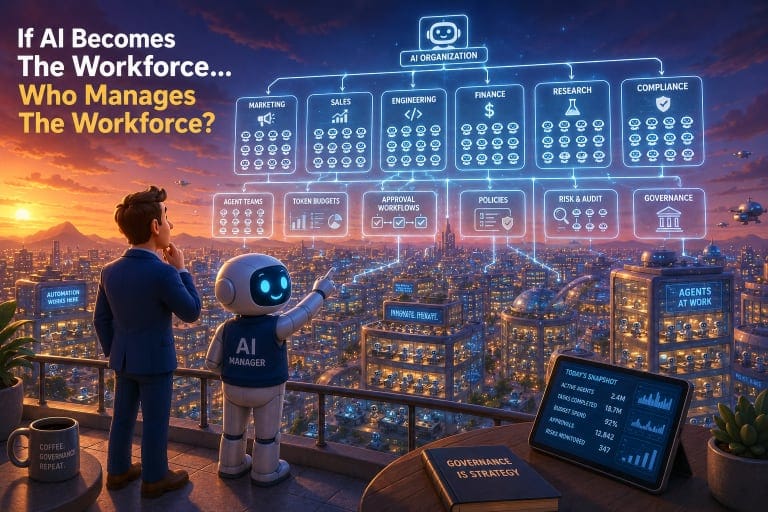
The vocabulary Paperclip uses is telling. The platform talks about org charts, agent hierarchies, budget controls, approval workflows, audit trails, and goal alignment. It's enterprise management software except that the employees are AI.
The analogy maps almost one-to-one:
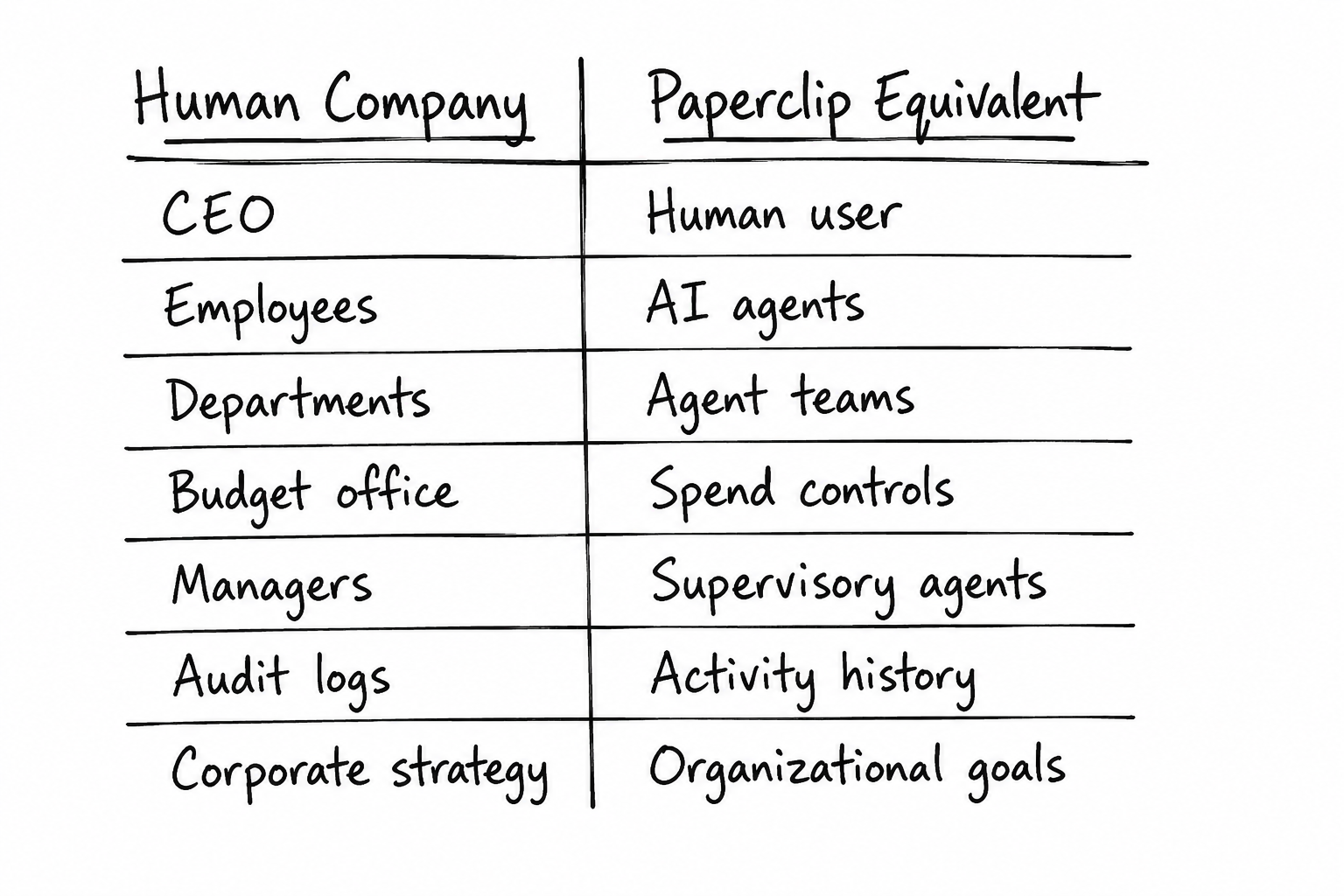
This is intentional. Paperclip isn't just coordinating tools; it's asking a much bigger question: If AI agents are going to run businesses, what does it look like to manage those agents like a business?
A Brief, Chaotic History of AI Agent Management
To understand why Paperclip exists, you need to understand what came before it and why it failed.
In 2023, AutoGPT and BabyAGI exploded onto the scene. They were proof-of-concept systems that showed GPT-4 could break down a high-level goal into subtasks, execute them, and iterate. The internet lost its mind. Repos hit millions of GitHub stars in a matter of days.
The reality was messier. AutoGPT failed in reasoning 15–30% of the time. Costs spiraled out of control because each subtask required expensive API calls. Agents got stuck in infinite loops, lost context, or made decisions no human would have approved. The infrastructure wasn't ready, the models weren't capable enough, and there were no guardrails anywhere. By the end of 2023, most serious teams had quietly shelved their AutoGPT experiments.
What emerged from that wreckage was more structured thinking. CrewAI introduced role-based agent teams. LangGraph brought graph-based workflow orchestration with proper state management. These frameworks helped, but they still left a massive gap: they told you how to coordinate agents technically, not how to govern them organizationally.
When you're running three agents, governance is optional. When you're running thirty, it becomes urgent. When you're running three hundred, it's survival. That's the window Paperclip is trying to occupy.
The Agent Sprawl Problem Is Real
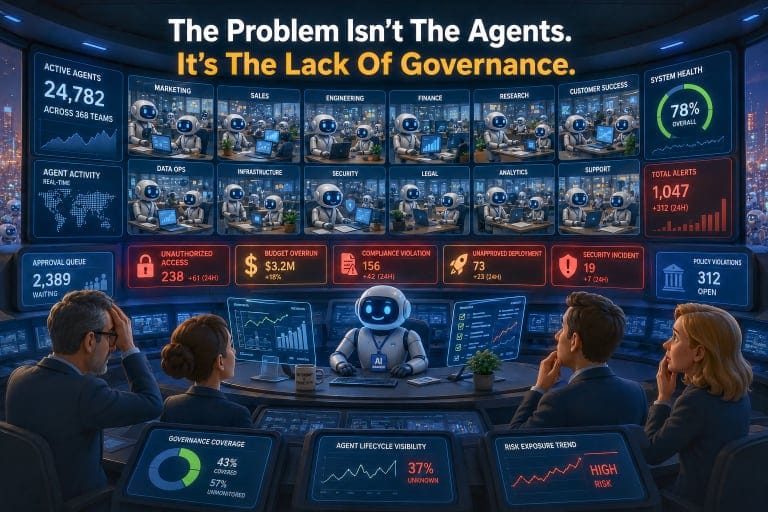
Walk into any mid-size enterprise in 2026, and you'll find AI agent sprawl disconnected bots that can't share context, duplicate each other's work, or worse, directly contradict each other. One team's marketing agent and another team's sales agent are pulling data from different sources and producing outputs that are misaligned. No one has a complete picture of what any agent is doing, how much it's costing, or who approved it.
The numbers are alarming. As of mid-2026, 88% of organizations had experienced confirmed or suspected AI agent security incidents in the past year. Only 14.4% of teams had full security and IT approval before going to production, meaning roughly six times as many teams were already building and testing agents without proper governance sign-off. Meanwhile, 65% of enterprises with deployed AI agents experienced a confirmed security incident, and 63% said they couldn't enforce purpose limitations on their agents.
This isn't a technology problem. It's a management problem. The agents are capable. The organizations deploying them are not ready to manage them.
The EU AI Act, which will enter full enforcement in 2026, makes this more urgent, as fines for violations can reach €35 million or 7% of global revenue. Forrester predicts 60% of Fortune 100 companies will appoint a dedicated head of AI governance this year alone. Morgan Stanley and BlackRock are factoring AI governance maturity into company valuations. The era of "move fast and deploy agents" is colliding head-on with regulatory reality.
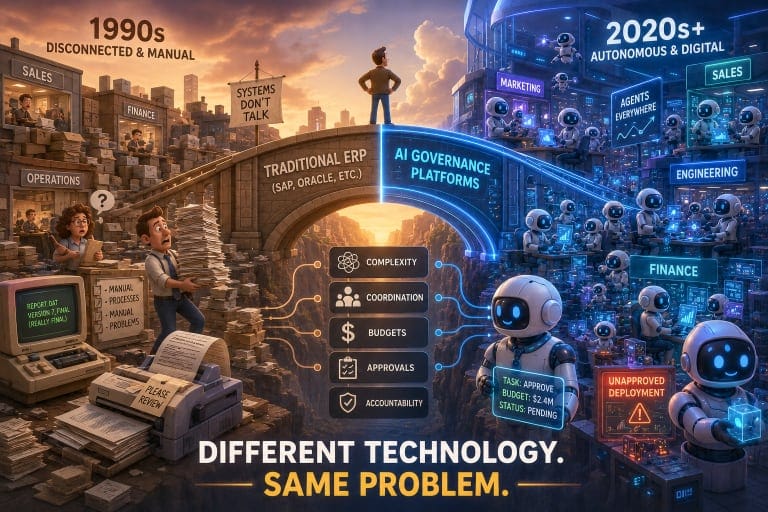
The ERP Hypothesis: Have We Seen This Movie Before?
Here's where Paperclip's thesis gets genuinely interesting and where the analogy to enterprise software history runs deep.
In the 1980s and early 1990s, companies faced a structurally similar problem with their human workforces: functional business models had grown too rigid, data was siloed, and no one had a real-time picture of the whole organization. The solution that emerged was the Enterprise Resource Planning system, SAP, Oracle, PeopleSoft, and eventually Workday and ServiceNow. These platforms didn't make companies smarter. They made them manageable at scale.
By 1998, approximately 40% of companies with annual revenues over $1 billion had implemented ERP systems. Y2K concerns accelerated adoption further. What had once seemed like expensive overhead became must-have infrastructure. The enterprise software market, which now exceeds $200 billion and is projected to reach $979 billion by 2034, was built to solve exactly this kind of management complexity.
The AI evolution looks structurally similar:
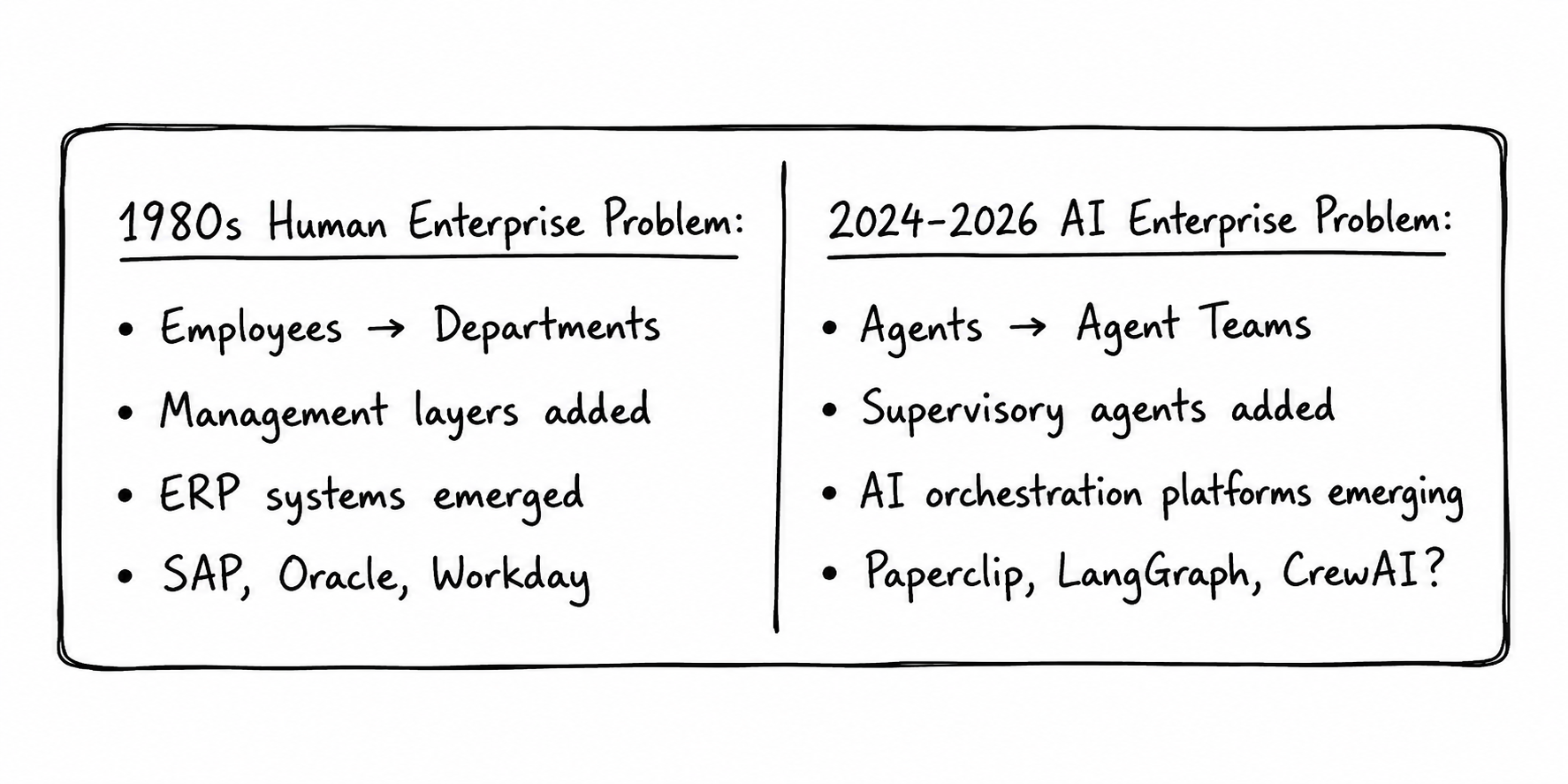
This is the bull case for Paperclip: every large organization that runs meaningful numbers of AI agents will eventually need structure, governance, accountability, and budgeting for those agents, just as they did for human employees. And that need will generate a software category worth billions.
SAP didn't create a corporate hierarchy. It digitized a preexisting hierarchy. Paperclip is betting it can do the same thing for AI.
The Competitive Landscape: Everyone Is Building a Piece of This
Paperclip isn't operating in a vacuum. The space it's trying to occupy is being attacked from multiple directions simultaneously.
CrewAI takes a role-based approach that maps naturally to human team structures. It defines each agent's role, goal, and backstory, then orchestrates through sequential or hierarchical processes. It's approachable for prototyping, but struggles with complex conditional logic and doesn't allow a delegating agent to review or revise a delegated task once it's been handed off.
LangGraph offers more sophisticated graph-based orchestration with checkpointing, human-in-the-loop capabilities, and production observability. It handles edge cases that break simpler sequential flows, but it doesn't feel like a true multi-agent system with dynamic planning; it's an orchestrator for well-defined processes.
Microsoft took the platform approach: Agent 365, announced at Microsoft Ignite 2025, is a centralized control plane that provides visibility, a registry, access controls, and security governance for AI agents across an organization, regardless of how those agents were created. ServiceNow launched AI Control Tower at Knowledge 2026, governing agent identities, permissions, and connected assets. SAP's Joule AI is now live across 35 solutions with 40+ specialized agents.
The big players aren't asking whether AI governance infrastructure will exist. They're trying to own it.
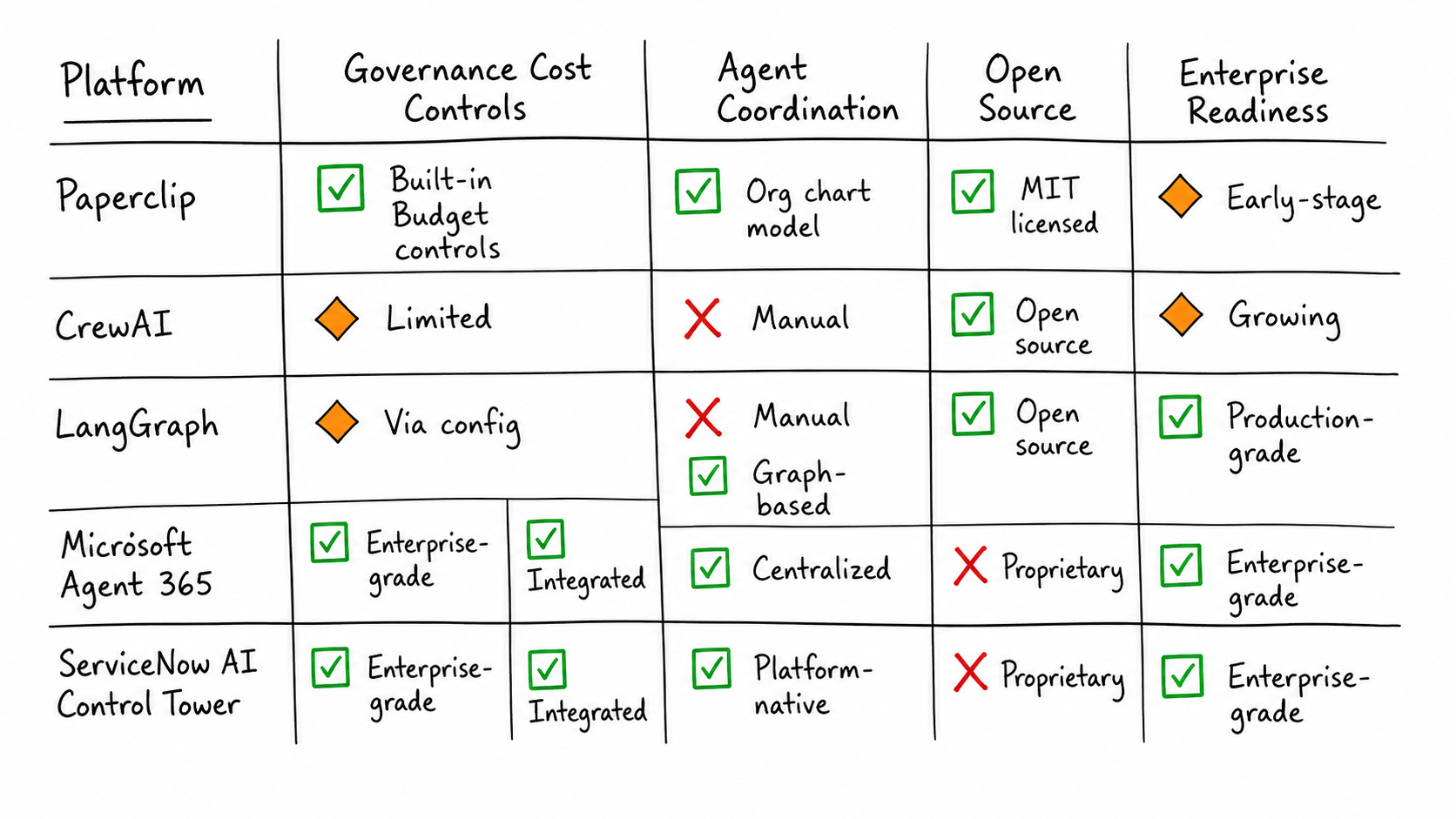
The honest competitive picture: Paperclip has the clearest vision of what AI organizational management should look like. It has far less scale than the platforms already embedded in enterprise infrastructure.
Why Paperclip Lost Momentum and Why It Might Not Matter
Paperclip emerged from a specific moment in AI thinking: the "many small specialized agents" paradigm. The assumption was that you'd have a research agent, a marketing agent, a finance agent, a coding agent, and an entire digital workforce of narrow specialists requiring coordination overhead.
Then models got dramatically more capable.
Claude 3.5, GPT-4o, and their successors showed that a single sufficiently powerful model could handle tasks that previously required a pipeline of specialized agents. The emerging "executive agent" pattern, one intelligent orchestrator that delegates to specialists as needed, began to challenge the assumption that raw agent count would keep growing linearly. If a single powerful agent can replace five mid-tier agents, you need less coordination infrastructure, not more.
This created real headwinds for Paperclip's pitch. The platform's complexity, org charts, budget systems, and approval chains felt heavy for individual users or small teams, who could achieve the same outcome with a well-designed single model. The learning curve disadvantaged adoption in a market that moves at startup speed.
But here's the counterargument: the executive-agent trend doesn't eliminate Paperclip's market; it redefines it.
Large enterprises are not going to run on a single executive AI agent. They're going to run on dozens of executive agents, each managing their own teams of specialists, across hundreds of departments, subject to different compliance regimes, budget owners, and regulatory requirements. The governance problem doesn't go away as models get smarter. It scales with them.
The question isn't whether individual users need Paperclip. The question is whether organizations eventually require it, just as individual employees never needed SAP, but organizations with 10,000 employees absolutely did.
Three Futures
The trajectory of AI agent management software will likely resolve into one of three scenarios over the next three to five years.
Scenario 1: Dedicated governance platforms win. As enterprises scale to thousands of agents, managing them becomes a distinct, critical function like IT, HR, or finance. Specialized platforms like Paperclip (or successors built on similar principles) become standard enterprise infrastructure, valued for the same reasons ServiceNow was valued: not for what they do, but for what they prevent. In this world, Paperclip is the SAP of AI.
Scenario 2: Workbenches absorb everything. AI operating systems, personal dashboards, unified interfaces, and mission control tools evolve to incorporate governance natively. The function of "managing agents" gets folded into the daily workflow interface, the same way email clients absorbed calendar management. Orchestration becomes a built-in feature rather than a standalone product. Paperclip's category gets absorbed rather than scaled.
Scenario 3: Hyperscalers take it all. Microsoft, ServiceNow, and SAP have existing distribution, existing enterprise relationships, and existing compliance architectures. They bolt AI agent governance onto their current platforms rather than let it become a separate category. This is already happening, and it may be the most likely outcome. The enterprise software market's $257 billion 2025 valuation didn't get there by allowing new categories to emerge unchallenged.
The hybrid outcome where Paperclip survives as the open-source, self-hosted, vendor-neutral alternative to proprietary platforms may be the most realistic path. Similar to how VMware became essential infrastructure by staying independent while proprietary alternatives surrounded it, there's a defensible position as the governance layer that works across OpenClaw, Claude Code, Codex, and whatever comes next, without requiring a corporate account to use it.
Why This Matters Right Now
Paperclip is not really a story about one open-source platform. It's a story about a question the entire AI industry is actively wrestling with: When AI agents stop being tools and start acting like employees, what does management software look like?
That question has a multi-billion-dollar answer. IBM's 2025 CEO study found that 61% of leaders were already adopting AI agents and preparing to scale them. KPMG's research confirms that enterprises are now in governance-heavy scaling mode, where trust, data quality, and risk controls are prerequisites, not afterthoughts. The gap between what agents can do and what organizations can control is, per Berkeley Haas's Agentic Operating Model research, the defining operational risk of this era.
The practical implications for anyone running AI agents today are concrete:
- For individuals and small teams: the overhead of a full governance platform isn't worth it yet. Start with clear prompting, human checkpoints, and cost monitoring.
- For teams scaling past 10 agents, you need structured role definitions, approval gates, and budget visibility. Whether Paperclip or a competing framework, something has to track what's running and why.
- For enterprises: governance isn't optional. The EU AI Act, NIST AI RMF, and ISO 42001 are all moving toward requiring it. The financial and reputational costs of a governance incident now exceed the cost of building governance architecture upfront.
The Closing Question
SAP didn't anticipate becoming the backbone of global commerce when it started selling accounting modules in Walldorf, Germany, in 1972. It solved a real, growing problem, found the right enterprise buyers, and built network effects through complementors and integrations until switching costs made it nearly permanent.
Paperclip is betting that AI agent management follows the same arc. The platform is early. The market is noisy. The established players are circling.
But the underlying problem is how do you manage a workforce you can't see, can't evaluate on performance reviews, and can't fire for cause? is not going away. It's getting harder every quarter.
Whether Paperclip specifically becomes the SAP of AI is genuinely uncertain. That something does not.
The next few years will determine whether AI orchestration platforms become a permanent software category or a temporary bridge until AI learns to manage itself. The smart money is currently building the bridge and not waiting to find out.