Stop Building AI Companies. Build AI Teams First.

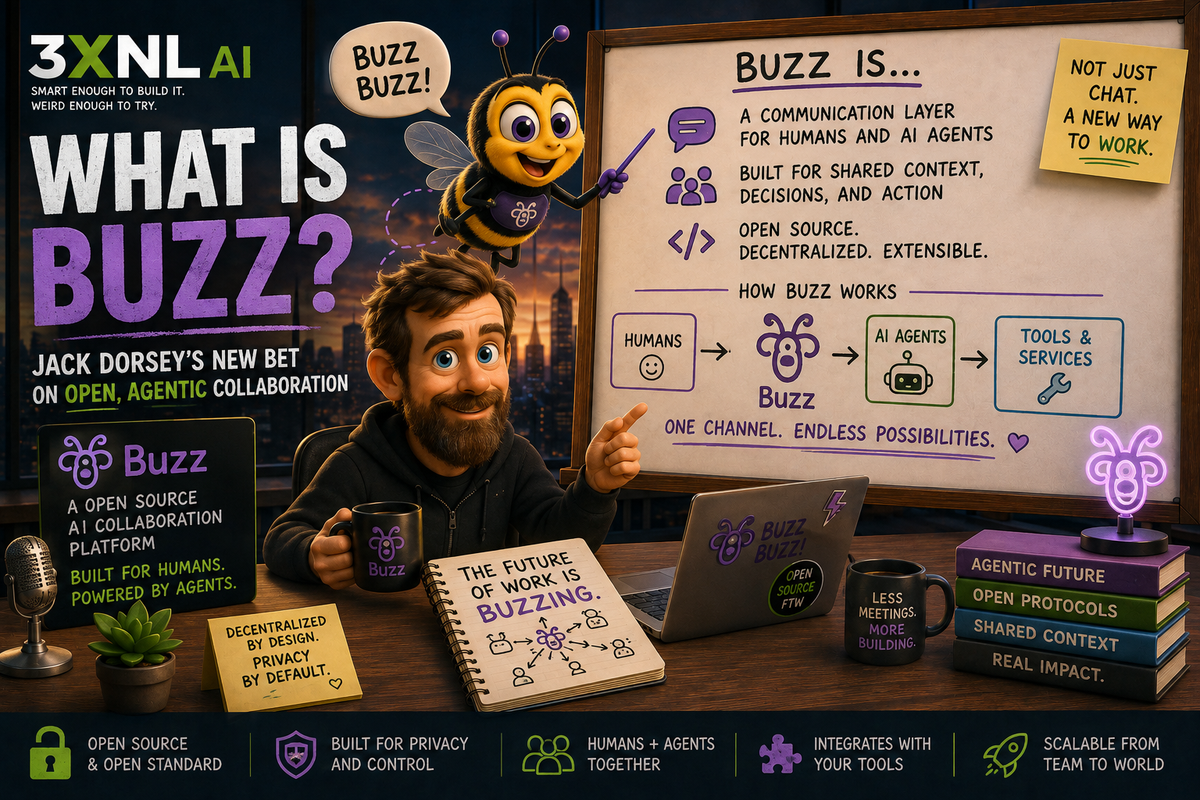
Jack Dorsey's Buzz bets that the bottleneck isn't smarter AI. It's AI nobody else can see.
TL;DR
Buzz in 60 seconds
Launched July, 2026, by Block · Nostr relay under the hood · agents are members with their own keypairs · self-hostable or Block-hosted · Git hosting included · desktop on macOS/Windows/Linux, mobile.
Ships today vs. still drying
Reproduce Block's own three-column README table. Working: relay, channels, threads, DMs, canvases, media, search, audit log, buzz-cli, ACP harness, YAML workflows, NIP-34 git events. Wiring up: mobile clients, workflow approval gates, huddle lifecycle. Pending: web-of-trust reputation, push notifications.
The privacy asterisk
Block-hosted relays are not end-to-end encrypted, and agent providers may receive channel content as prompt context. Self-hosting fixes the relay, not the model provider.
The smartest person in your company is a chat window nobody else can open
Five people start a company on Monday.
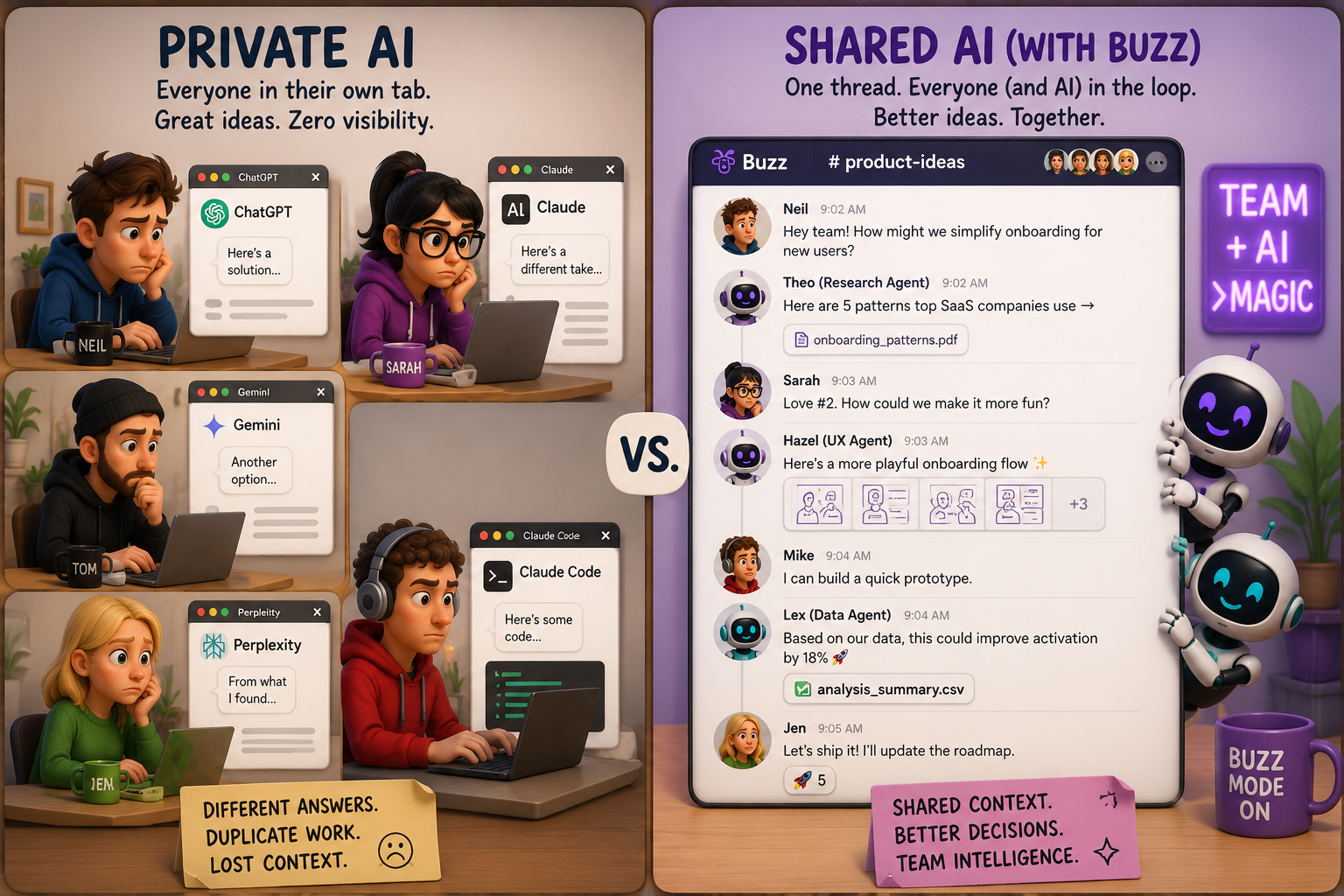
One lives in ChatGPT. One swears by Claude. The designer likes Gemini. The developer has not voluntarily left Claude Code since March. Marketing runs everything through Perplexity, including, one suspects, personal decisions.
By lunch, all five have had a genuinely good idea.
By Friday, four of those ideas are gone, one has been independently re-derived twice by two people who will never find out, and nobody can reconstruct why the team chose Postgres over DynamoDB. The reasoning happened in a private thread on somebody's laptop, and that laptop is now in a bag, at an airport, asleep.
Here is the uncomfortable part. Every one of those five people got more productive. Measurably. Provably. You could put it in a board deck.
And the team got slower.
We spent three years optimizing the individual-to-AI relationship and, in the process, accidentally invented a new form of organizational amnesia. AI did not create silos. Email and Slack had that market cornered decades ago. AI created invisible silos, which are worse, because a silo you can see is a problem, and a silo you cannot see is a culture. The work product looks like a finished thought. The reasoning behind it evaporates the instant someone closes the tab.
The bottleneck is no longer access to intelligence. It is shared intelligence.
That is the problem Buzz is aiming at. Whether or not Buzz survives contact with the market, the problem is real and worsening on schedule.
1. What Buzz actually is (and what it isn't)
In July 2026, Block, Jack Dorsey's company, the one behind Square and Cash App, shipped Buzz: a free, open-source team workspace under the Apache 2.0 license. Desktop apps for macOS, Windows, and Linux, with iOS and Android clients following within days.
Dorsey's own framing on X: "a new group chat platform for teams of people and agents of all sizes, built to reduce our dependency on Slack and GitHub. model-agnostic, decentralized, self-sovereign, and open source."
Open it, and it looks aggressively familiar. Channels in a sidebar. Threads. DMs. Emoji reactions. Voice huddles. Media sharing. If you have used Slack, there is no learning curve, which is either excellent product discipline or a quiet admission that this UI is now a law of physics.
The difference is one architectural decision, and everything downstream flows from it.
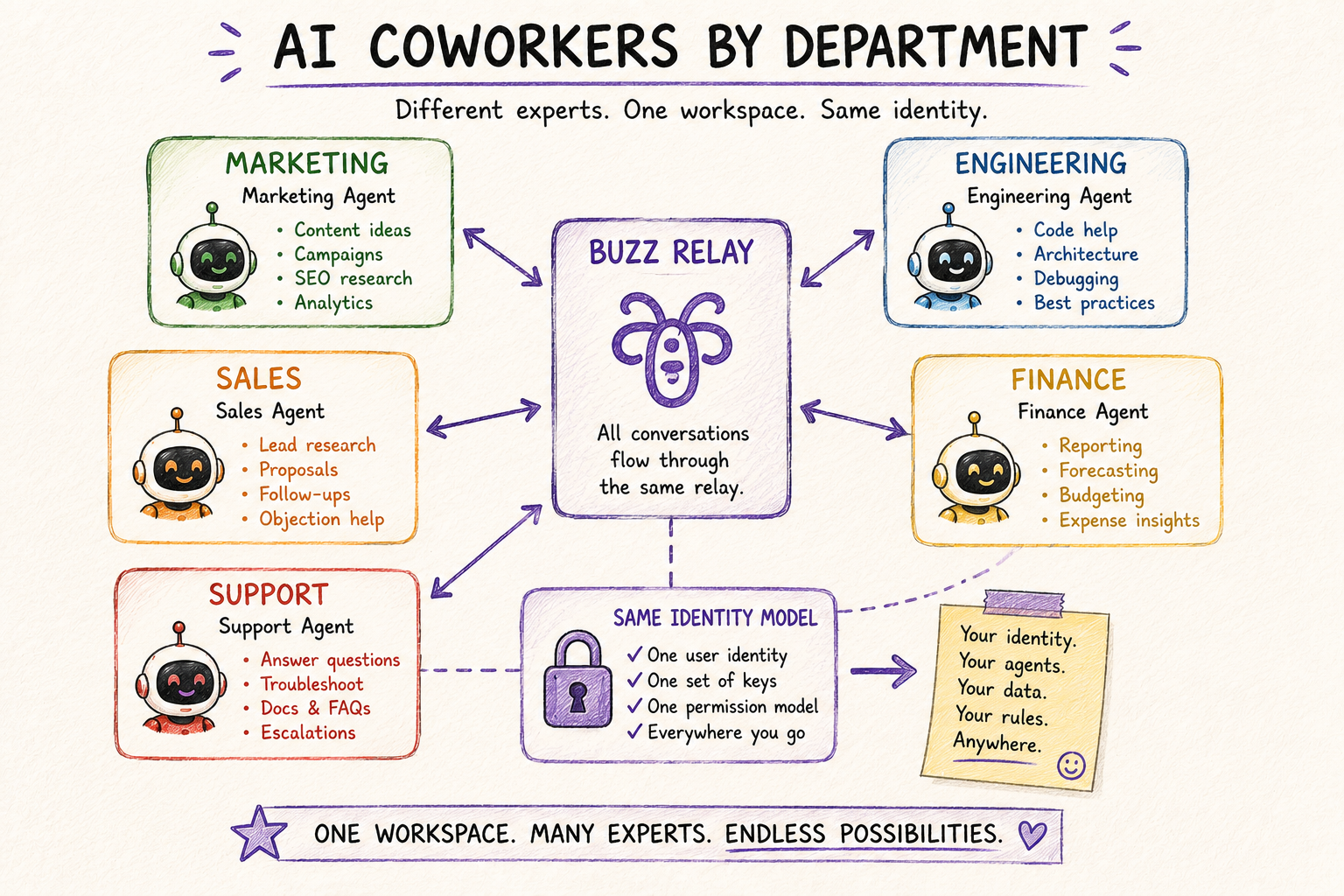
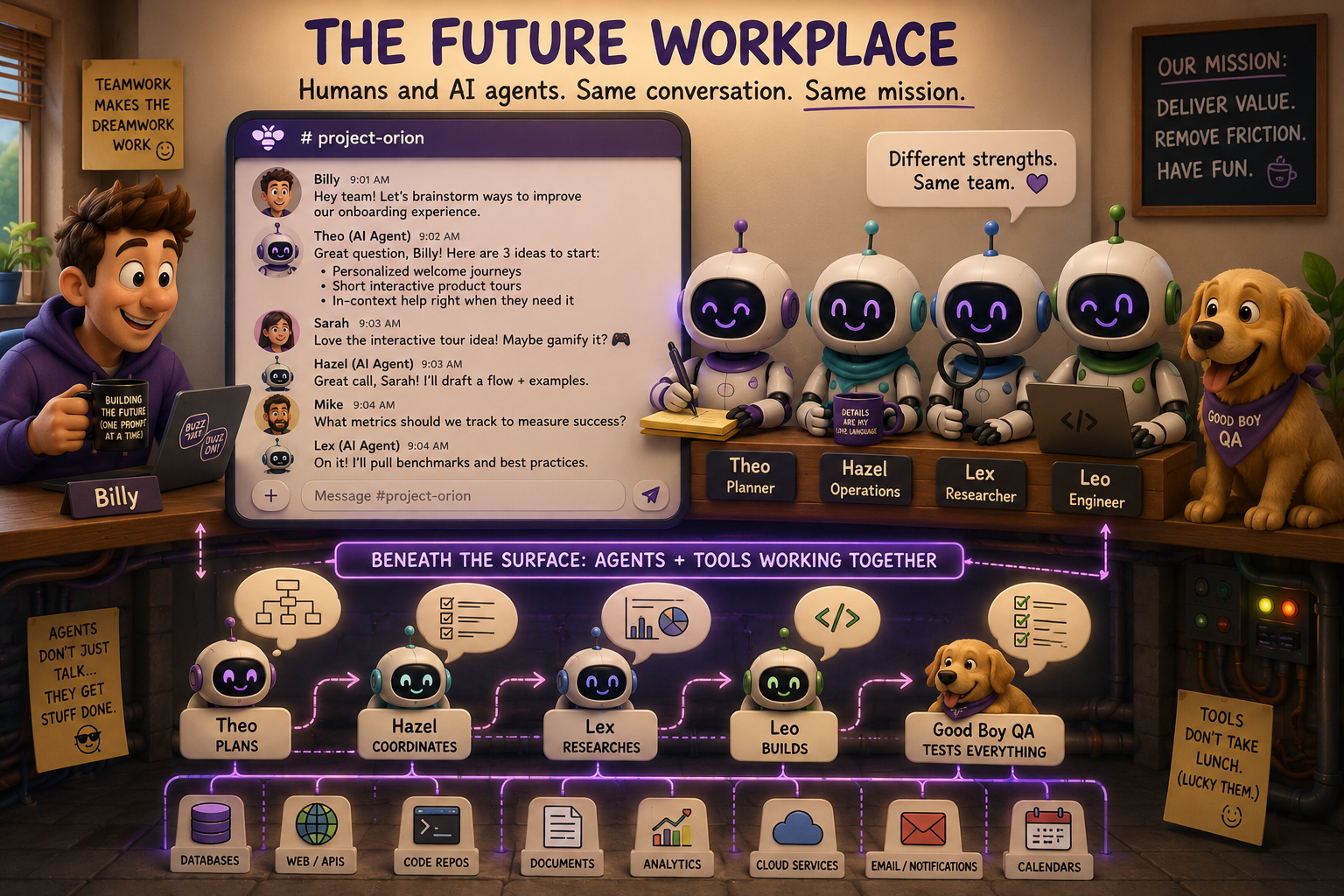
In Slack, an AI is an app. In Buzz, an AI is a member.
That sounds like a landing-page slogan until you look at the identity model. Every participant in Buzz, human or agent, holds a secp256k1 keypair: the same elliptic-curve cryptography that secures Bitcoin. Humans get a keypair. Agents get their own keypair, along with a second signature that ties the agent back to the human who owns it.
Block calls this a verifiable chain of custody. In practice, it means that when an agent merges a pull request at 3am, the signed record shows not just that the agent did it, but which human authorized that agent to act. Which is to say: the 3am pull request now comes with a name attached, and that name is yours.
Compare that to how AI works in Slack today. Bots authenticate with app tokens: shared secrets, held by an integration, usually scoped far more generously than anyone intended and never scoped back down. When something goes wrong, you reconstruct intent from logs, in a meeting, on a Saturday. In Buzz, accountability is baked into the message format itself. It is harder to lose, and considerably harder to hide behind.
The substrate is Nostr, an open protocol where every event is a signed JSON object. Buzz's own README is refreshingly blunt about it:
"It's a Nostr relay: every message, reaction, workflow step, review approval, and git event is a signed event in one log. Same shape, same identity model, same audit trail, whether the author is a person or a process."
That last clause is the entire thesis. Your conversation, your code review, your CI result, your approval, and your agent's action are all the same kind of object, in the same log, searchable in the same index. One shape. No translation layer. Nothing quietly falls into the gap between two systems that were never designed to speak.
(Buzz ships Git hosting too, using NIP-34 events for patches and repo announcements. The pitch: the argument about a feature and the pull request for that feature should live in the same room. Radical, apparently.)
What it isn't. Block is unusually honest here. Their documentation splits features into three columns: "Works today," "Being wired up," and "Strong opinions, pending code." It carries a warning that deserves to be framed: "Please do not plan your compliance program around the 💭 column yet." Workflow approval gates are described as glue still drying. This is a fast-moving v0.4.x product, not a finished enterprise suite, and the people who built it will tell you so before you find out for yourself.
2. Private AI versus shared AI: the actual delta
Here is the current workflow. You did it today.
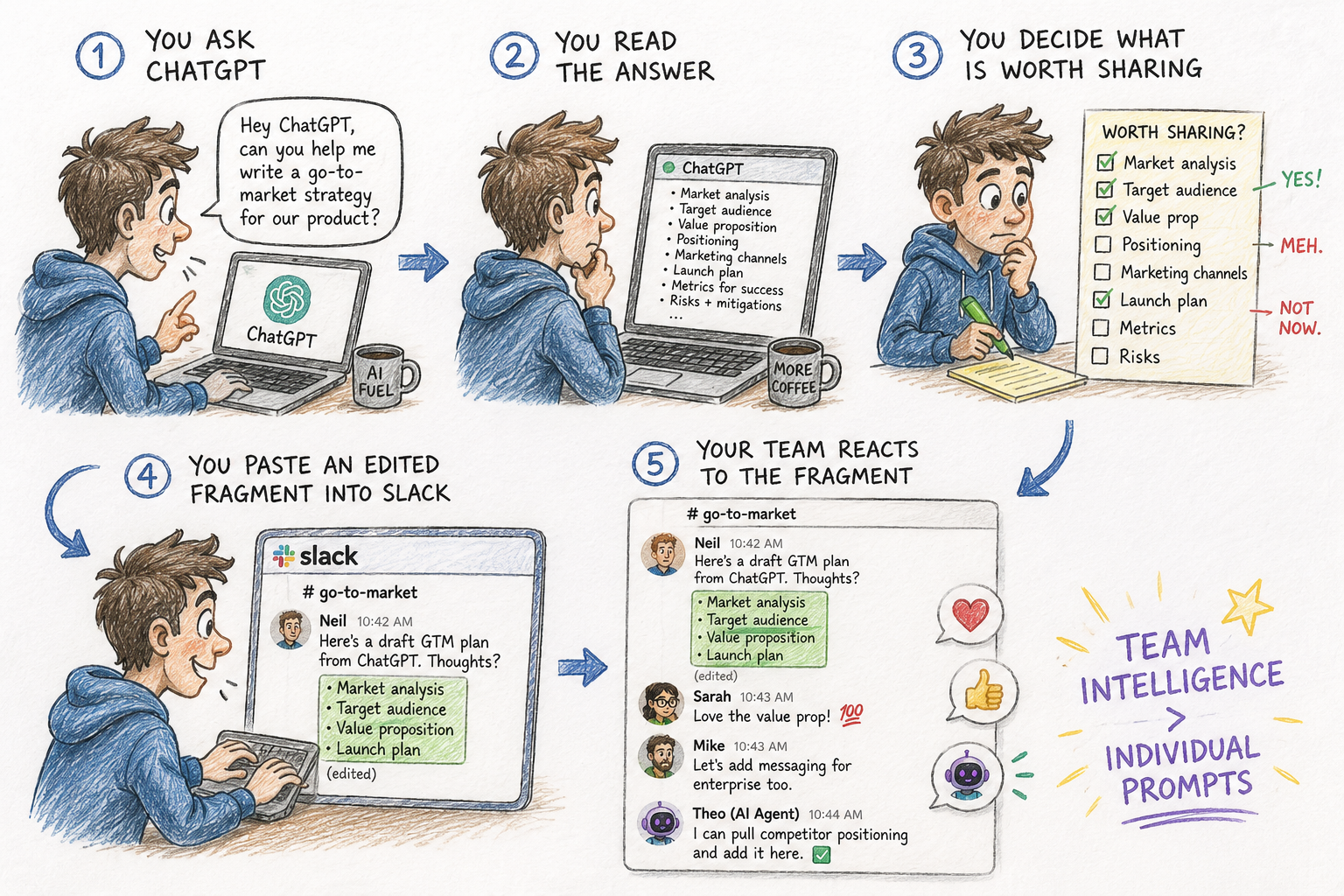
Three lossy compressions happen in that chain. The prompt is gone. The rejected options are gone. The follow-up where you caught the model inventing a citation is very gone, because nobody screenshots their own corrections. Your team receives a conclusion with no visible reasoning, leaving them with exactly two available moves: agree or object. They cannot build.
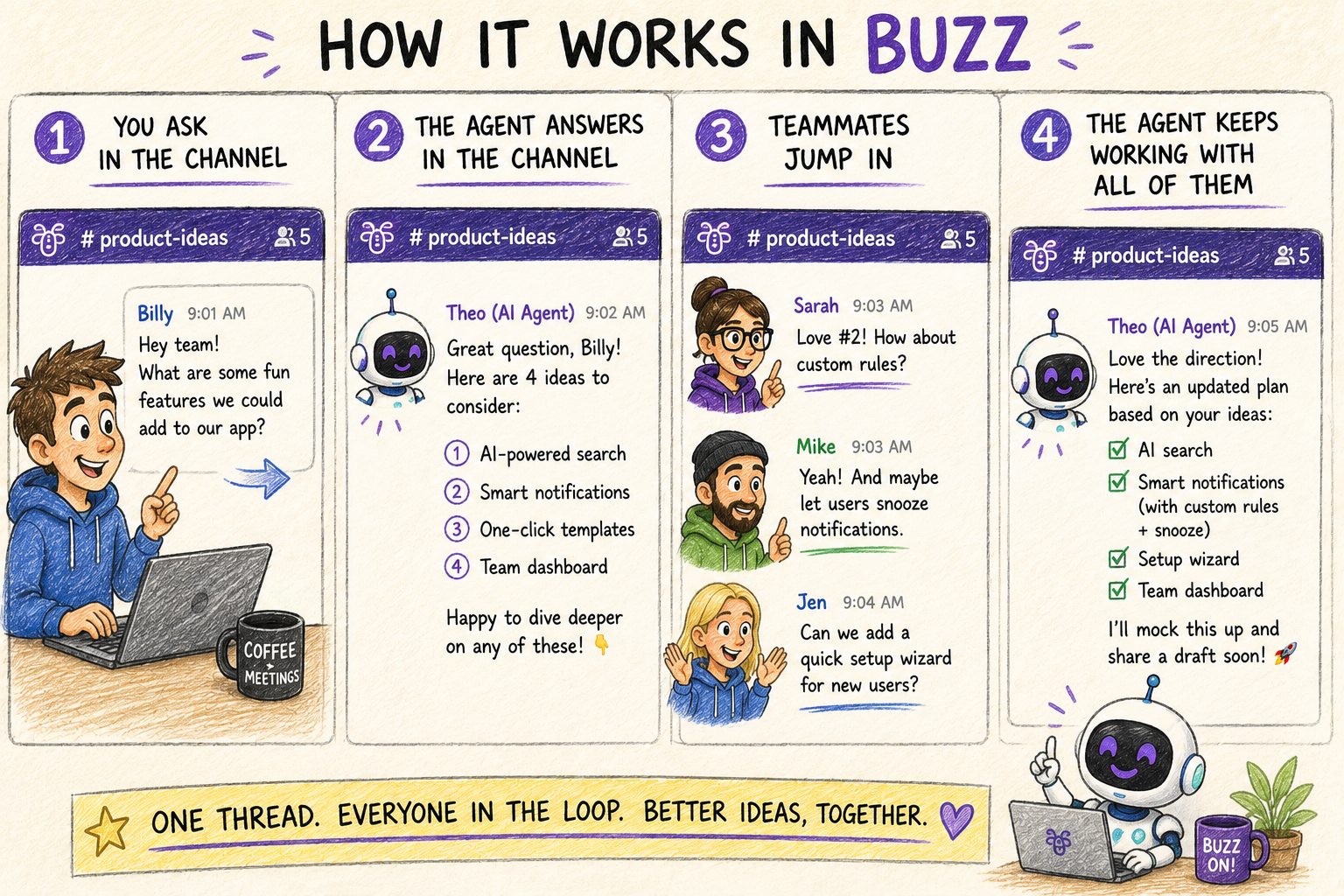
The shift is not "AI in your chat app." The interaction pattern changes from Human ↔ AI to Human ↔ Human ↔ AI ↔ Human. The agent is not answering a person. It is participating in a conversation with several people, each of whom can correct it, extend it, or drag it somewhere better.
Anyone who has sat through a good design review knows the difference. One expert answering one question is useful. Four people arguing productively while an expert supplies evidence on demand is how good decisions actually get made. The second one is louder, messier, and corrects more often.
Block's README gives a concrete version:
"It's 2am. You type 'have we seen this error before?' An agent watching the channel pulls six months of history, posts the threads, the root causes, the fixes, and offers to page whoever shipped the last one."
Note the phrase "an agent watching the channel." Not an agent you summoned with a slash command like a medieval spirit. An agent that was already in the room, with membership and context, the way the senior engineer who has been there for four years is already in the room, and already knows exactly who shipped it.
3. The three benefits nobody puts on the landing page
The pitch deck says "collaboration." The real value is quieter and arrives months later.
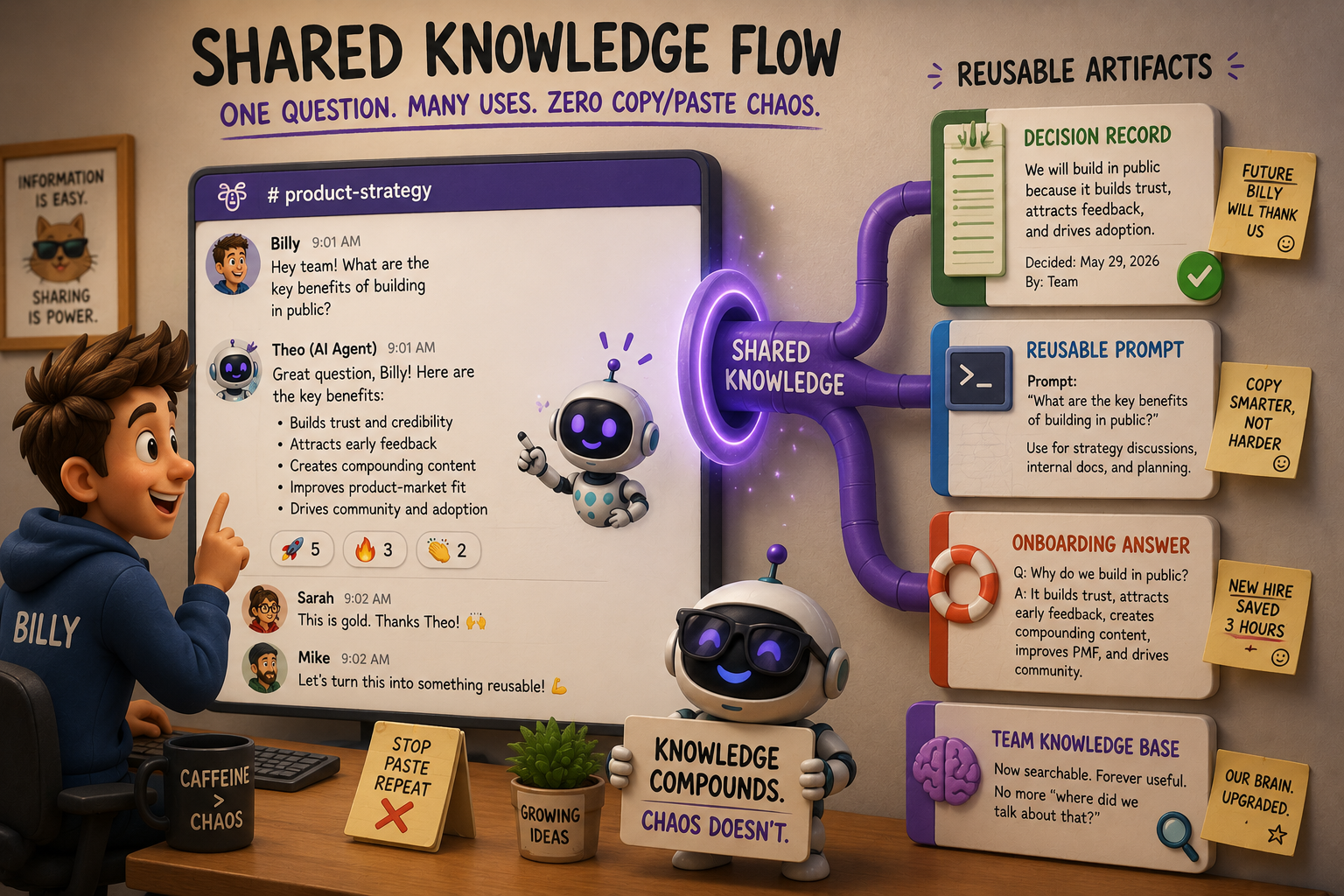
1. Prompting stops being a private skill.
Right now, prompt engineering is tribal knowledge in the worst possible sense: the knowledge of one. Your best prompt writer has a technique that would make everyone else meaningfully better, and there is no mechanism by which anyone learns it. It lives in their history, between a recipe and a dispute with an airline.
When AI conversations happen in shared channels, that technique becomes visible by default. Someone gets a spectacular result, and four people scroll up to see how. This is how craft has always spread: apprenticeship by observation. Private chat windows quietly deleted it while everyone was celebrating their productivity gains.
2. AI literacy becomes ambient instead of scheduled.
Every company running "AI enablement training" is fighting the wrong battle with a slide deck. People do not learn to use AI well in 45 minutes and a certificate. They learn it from watching a colleague catch a hallucination, push back on the model, and get a better answer on the third attempt.
The verification instinct, the reflex that says "that citation looks fake, check it", is the single most valuable AI skill and the hardest to teach in the abstract. It transmits by demonstration, the way suspicion always has. Shared workspaces make demonstration the default setting rather than a training budget.
3. Institutional memory gets receipts.
Block's phrase is "an answer with receipts": agents search history and post the actual threads, not summaries. Because the conversation, the patch, the workflow run, and the approval are all events of the same type, you can search across all of them at once.
The onboarding version of this is genuinely different from the status quo. A new hire asks, "Why do we do it this way?" and instead of conducting an archaeological dig for the one person who remembers, they read the room where the decision happened. Including the AI-assisted analysis that informed it. Including the objections that got overruled, which is usually the interesting part, and the part that never survives into the wiki.
And the honest fourth one: fewer meetings. A meeting is frequently just a synchronous ritual for gathering context that nobody wrote down. When the context already sits in a searchable log, and an agent can summarize the state of a decision on request, the ritual loses its excuse. Not zero meetings. Fewer meetings. Let us not lie to each other in a piece about audit trails.
4. Where it stops being chat and starts being infrastructure
If Buzz were just a nicer Slack, it wouldn't be worth 3,000 words. The interesting layer is what agents can actually do once they are inside.
From the README, agents can "open repos, send patches, review code, run workflows, edit canvases, orchestrate other agents, drop into voice huddles, create channels, and pull in whoever needs to see it. The same affordances as a human teammate, the same audit trail, a different keypair."
Read "orchestrate other agents" again. That is multi-agent coordination happening in a channel, in the open, where humans can watch it and step in. Every other version of this is a black box that emits a result and a bill.
How agents actually connect. Buzz exposes two surfaces. buzz-cli It is an agent-first CLI: JSON in, JSON out, explicitly designed to be called as an LLM tool. buzz-acp is a harness bridging Agent Client Protocol over stdio, with shipping support for Goose, Codex, and Claude Code.
That is the model-agnostic claim made concrete. Buzz does not ship an AI. It ships a socket. Claude, Codex, Goose, OpenClaw, or a local model on your own GPU: Buzz does not care which brain is on the other end, which is the healthiest attitude anyone in this industry has taken toward model loyalty.
Where MCP fits. Buzz itself does not broker MCP connections. The repo recently removed a vestigial MCP toolsets config from the desktop app. Tool access comes through the agent instead, and that is fine, because Block also built Goose: the open-source agent that was the first public MCP client and now serves as the protocol's reference implementation. Goose connects to 70+ extensions covering databases, APIs, browsers, GitHub, and Google Drive over MCP. Block runs an MCP server for every internal app they use, which is either admirable discipline or a hostage situation, depending on who you ask internally.
So the real stack is:
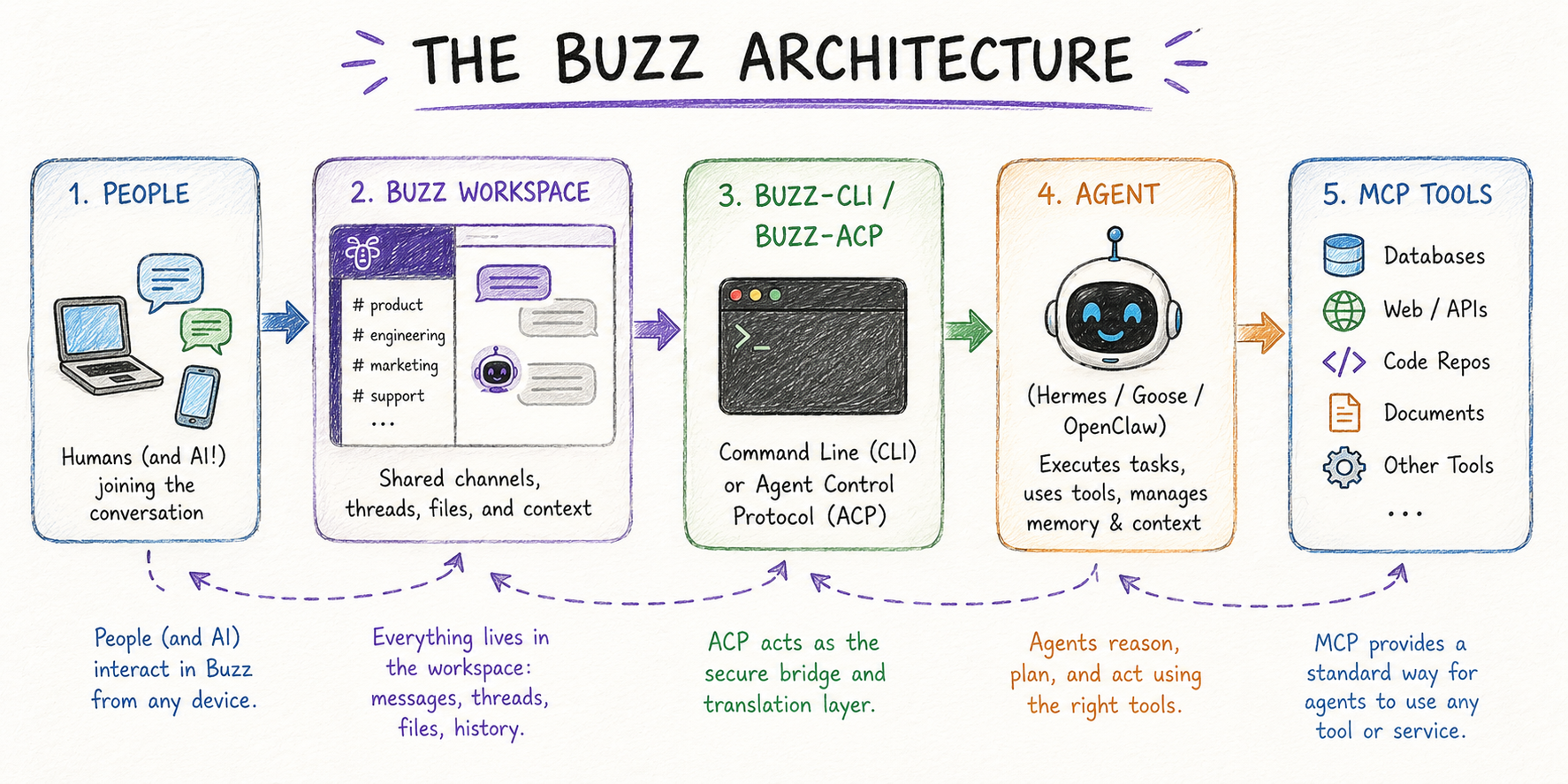
Buzz owns the room and the record. Your agent owns the brain and the tools. That separation is the design, and it is precisely why Buzz does not have to win the model war to be useful. It has opted out of the war entirely and rented out the battlefield.
The automation layer. YAML workflows with message, reaction, schedule, and webhook triggers, shipping today. Which means the multi-agent content pipeline you are already imagining (draft → SEO review → copy edit → graphics → social → schedule) is expressible as declarative config, with humans able to react-to-approve at any step. Block's own example: a workflow fires on a git tag, an agent drafts release notes from merged PRs, posts them for review, collects a 👍, and ships. Every step is signed and searchable.
The 👍-as-approval-gate is a small detail that tells you this team has actually used the thing they built. Approval should not require a different tool from the one where the conversation happened. Somewhere, a procurement platform with a seven-step approval matrix just felt a chill and does not know why.
5. The part where I stop being a fan
Four real limits. One of them is not a bug you can patch.
Privacy on the hosted relay. Messages and media on Block-hosted relays are not end-to-end encrypted, and agent providers such as Anthropic and OpenAI may receive prompts and related channel content. Read that again in light of everything above, because the shape of it is genuinely nasty. The entire value proposition is put more of your team's thinking into the shared channel. Which means the exposure surface grows in exact proportion to the product's effectiveness. Success is the risk. You can self-host to fix the relay side. You cannot self-host away the fact that a cloud model reading your channel for context is, in fact, receiving that context.
Open source is not the same as zero operational burden. Self-hosting wants Docker, Rust 1.88+, Node 24+, and pnpm, plus Postgres, Redis, and S3/MinIO for media. If you run a homelab, this is a pleasant Tuesday. If you are a three-person agency, it is a legitimate reason to use Block's free hosted relay, and now you are back in the previous paragraph, holding the tradeoff you were trying to avoid. Choose deliberately. The default is a decision too, just one you did not attend.
Maturity. v0.4.x, four months old, approval gates half-wired, push notifications aspirational. Buzz is a serious project. It is not yet a serious product, and those are different nouns with different insurance implications.
The social question, which nobody has solved. The productivity case for public AI conversations is airtight. The social case is not. Asking a naive question in a private chat window costs nothing. Asking it in a channel where your team and your boss can both read it costs something, and people are excellent at calculating that cost instantly and silently. That friction is small, real, and exactly the class of thing that has killed better-designed tools than this one. Buzz's architecture is excellent. The unsolved problem is human, and it always was.
The honest read: for a team of three to ten, Buzz probably covers 90% of what you actually need. Shared thinking, shared AI, shared decisions, one audit trail. What it does not cover is the stuff you do not need yet: long-horizon memory, cross-department routing, compliance workflows, governance dashboards, enterprise SSO, and large-scale automation.
That is not a criticism. That is a roadmap for the company you become.
6. Where Hermes fits, and why this stopped being hypothetical
I expected to write this section speculatively. Then I checked, and the integration had already shipped, which is roughly the pace of everything now.
Hermes Agent, from Nous Research, is an MIT-licensed open-source autonomous agent released February 25, 2026, built around a self-improving loop: it creates skills from experience, refines them in use, and builds a persistent model of its user across sessions. It runs on your infrastructure, whether that is a $5 VPS, a GPU cluster, or serverless. Nous is reportedly closing a round at a $1.5B valuation, because of course it is.
On July 30, 2026, Nous published three documented integration paths into Buzz. The one that matters most is buzz-acp, which bridges a Buzz channel to Hermes over ACP/stdio, relaying across a persistent NIP-42-authenticated Nostr WebSocket with dependency-free BIP-340 signing, and automatically falling back to CLI polling every 4 seconds if the socket drops.
Translated: Hermes can now hold a Buzz identity and sit in your channels as a member.
Which makes the architectural relationship unusually clean:
Buzz is where humans collaborate. Hermes is where agents think.
Buzz supplies the room, the record, the identity model, and the audit trail. Hermes supplies memory, learned skills, and autonomous execution. Neither one wants to be the other, which in this industry counts as a personality trait.
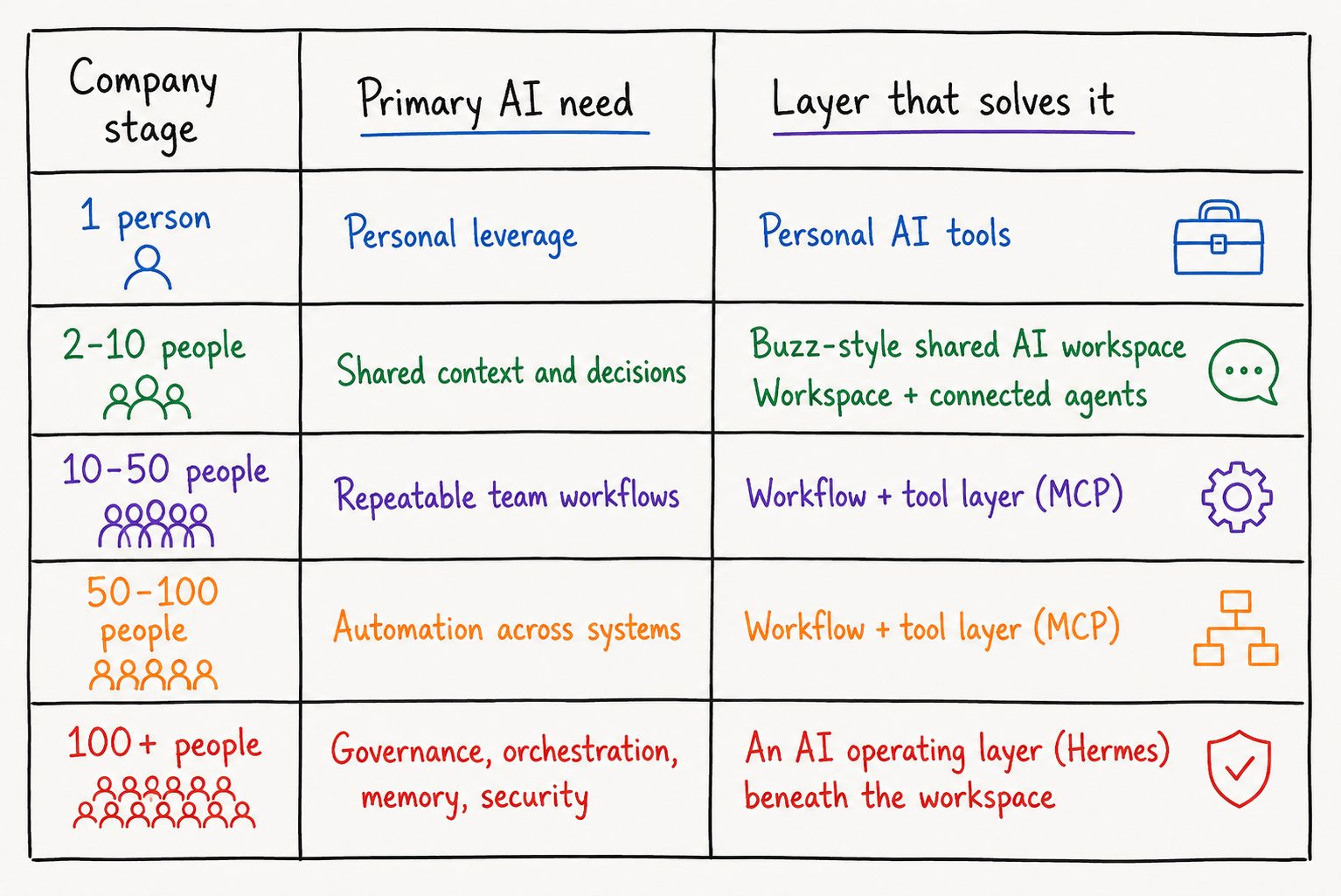
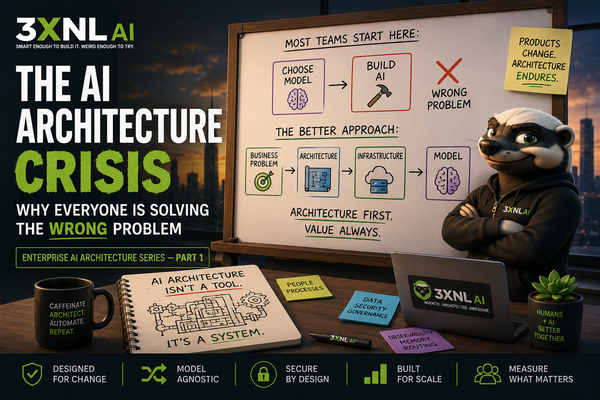
Most teams try to skip straight to the last row. They set up the orchestration platform, the routing engine, and the observability dashboard, then discovered that nobody knows what to route, because the team never learned to think with AI together in the first place. The dashboard works beautifully. It is displaying nothing.
You cannot build an AI org chart without an AI workflow.
Why this matters right now
Zoom out, and Buzz stops looking like a quirky Dorsey side project and starts looking like the open-source instance of an industry-wide convergence.
Salesforce made the AI-native Slackbot generally available on January 13, 2026, positioning Slack as the conversational interface where employees and agents work together, wired into permissioned conversations, files, workflows, and Salesforce data. Microsoft shipped Agent 365, giving every AI agent its own Entra Agent ID with lifecycle and access management, GA since May 1, 2026, with third-party agents from Bedrock and n8n onboardable via workload identity federation. Okta launched an agent IDP that discovers shadow agents, assigns each one a human owner, issues short-lived credentials instead of long-lived tokens, and provides a kill switch for rogue agents. That last phrase is doing a lot of quiet work, and you should sit with it.
Notice the convergence. Slack, Microsoft, Okta, and Block independently concluded that "agents need real identities with human owners and audit trails." That is not a trend. That is four organizations hitting the same wall from four directions, each describing it.
The difference is how much you have to buy to get through it. Microsoft's version wants M365 E7, or an Agent 365 license plus Entra P1. Slack's Slackbot is available only in Business+ and Enterprise+. Buzz's version is Apache 2.0 and runs on your hardware.
For a five-person company, that gap is the entire decision.
The practical implication this quarter: the question shifts from "which AI subscription do we buy?" to "what should our AI teammate do, what should it be allowed to touch, and who is accountable when it acts?" That is an org design question wearing procurement question's clothes, and it will be routed to whoever handles vendor contracts, where it will be answered incorrectly by someone with no authority to answer it. It is also the question that determines whether AI compounds in your company or merely makes five people individually faster and collectively confused.
What's coming next
Three things to watch.
Agent identity standardizing. Okta, Microsoft, and Block are all converging on human-owned agent identities with revocable, short-lived, auditable credentials. Whether the winner is OIDC-based or Nostr-based, the concept is settled. Expect "who authorized this agent to do that?" to become a routine audit question by 2027, and a routine deposition question shortly after.
Chat is becoming the orchestration surface. Slack, Teams, and Buzz are all betting that the channel is where multi-agent work gets coordinated and approved. This is a real bet, not an obvious one. The alternative future is a dedicated agent control plane in which chat is demoted to a notification feed. Genuinely unresolved, and anyone telling you otherwise is selling one of the two.
Open-source pressure on the collaboration stack. Buzz is free, self-hostable, and model-agnostic. It does not have to beat Slack to matter. It only has to make "AI agents as first-class members with cryptographic identity" a table-stakes expectation, at which point every incumbent has to ship it, quickly, and at a price that is not an enterprise SKU. That is a much lower bar, and it is the one Buzz is actually jumping.
Build the team before you build the company
Every startup eventually asks when it needs real infrastructure. AI will be no different, and most teams will guess wrong, because the AI infrastructure vendors have every incentive to tell you the answer is "now," and a sales quota that makes it sound sincere.
It is not now. Your first problem is not orchestration, governance, routing, or an AI operating system. Your first problem is that five smart people are having five separate conversations with five different models and calling it a strategy.
Fix that, and everything after it becomes a scaling problem. Scaling problems are the nice kind.
The future probably is not Buzz or Hermes. It is Buzz on top of Hermes, the same way your browser sits on top of your operating system, and neither one is confused about its job.
One helps humans work together.
The other helps everything else work at all.
The teams that figure out the first part now will be the only ones in any condition to survive the second.