The AI Architecture Crisis: Why Everyone Is Solving the Wrong Problem
You'd never rebuild your ERP system because Intel shipped a faster chip. So why is every enterprise AI strategy built to be torn up the moment a better model appears?

Enterprise AI Architecture Series - Part 1 of 9 · Start with the series introduction
Imagine rebuilding your entire ERP system every time Intel shipped a faster CPU.
Ridiculous.
You'd never do it. The chip is faster, sure, but your accounts payable process, your supply chain logic, and your decades of institutional workflow don't care which silicon sits underneath. You designed a system that treats the processor as a replaceable part. That was the whole point.
Now look at how most organizations are approaching AI. They are, quite literally, preparing to redesign their systems whenever a better model emerges.
And a better model appears constantly.
That's the architecture crisis. The industry is getting this wrong, and it's doing so in a specific, expensive, entirely predictable way.
The Tuesday Morning Problem
You know the ritual by now. Every Tuesday morning, someone releases a new model. X declares a new winner before lunch. Benchmark charts explode across every feed. YouTube thumbnails announce that some incumbent is "dead." A hundred thousand professionals quietly reopen the same spreadsheet to re-rank the same contenders.
Kimi. Claude. GPT. Gemini. DeepSeek. Qwen.
The names rotate. The frenzy doesn't.
Many of the specific conversations dominating your feed today did not exist six weeks ago, and six weeks from now, they'll have moved on again. That isn't a hunch. One public tracker following ten major labs recorded frontier model releases climbing from 20 in 2023 to 51 in 2024 to 82 in 2025, with 43 more already shipped through mid-July 2026. The three largest labs have compressed their release cadence to roughly one new model every 50 days, down about 62% from their three-year average.
So here is the question this article is built around:
If the "best model" changes every month, why are companies designing long-term strategies around it?
That sounds rhetorical. It isn't. Answering it honestly is the difference between an AI program that compounds in value and one that quietly collapses under its own weight.
The Wrong Question Has a Price Tag
Walk into almost any enterprise AI steering meeting, and you'll hear a version of the same sentence:
"What model should we standardize on?"
It feels responsible. It feels like leadership. It is a tactical question wearing a strategic suit.
Here is what that meeting almost never asks:
- What architecture are we actually building?
- How will we replace this model when a better one arrives?
- How will we observe what it's doing in production?
- How will we govern it?
- How will we route requests between models?
- How will we control costs as usage scales?
- What happens the day something better ships, and it will?
Notice the shape of the two lists. The first question is about a product. The second set is about a system. One of them expires in 50 days. The other, done well, serves you for a decade.
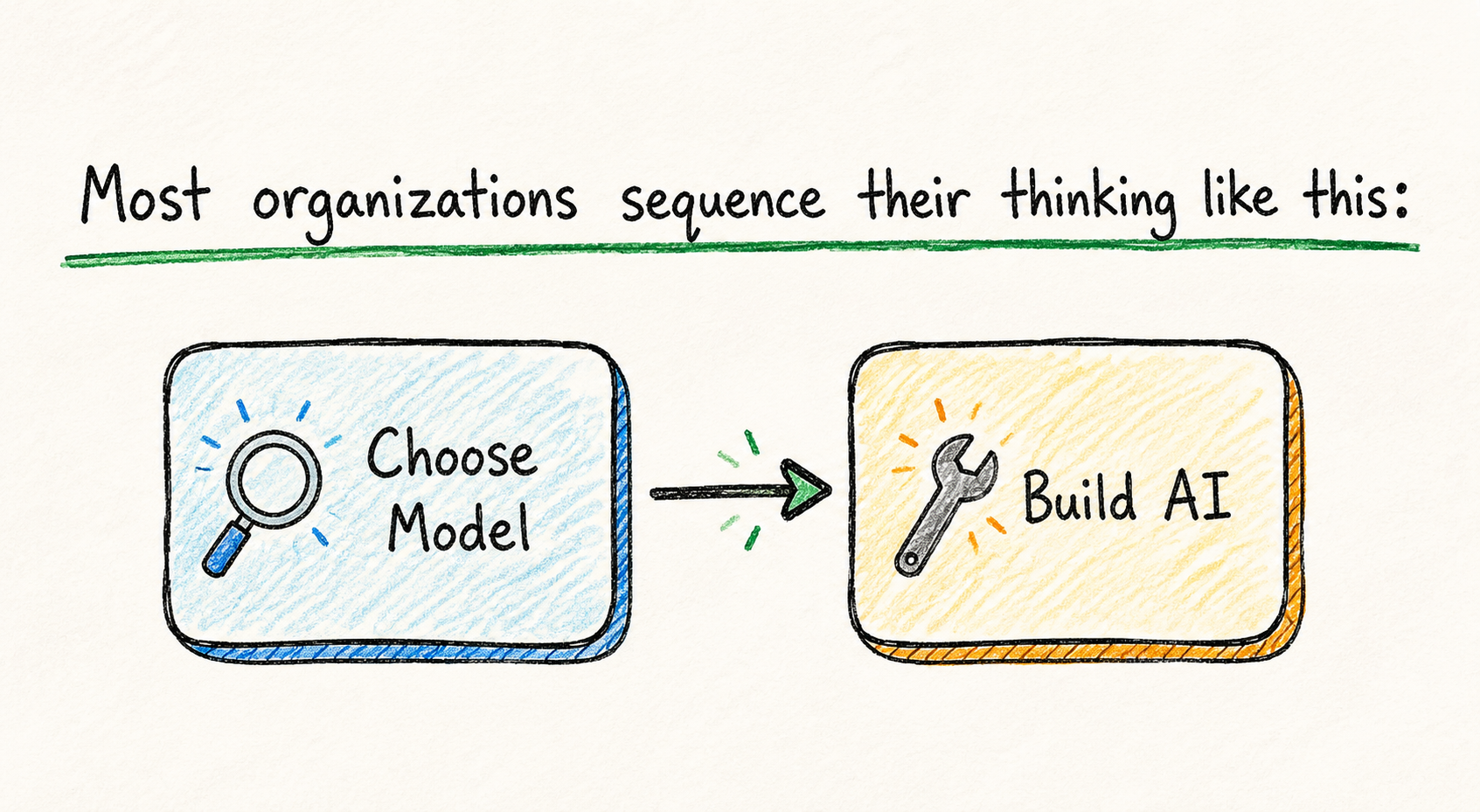
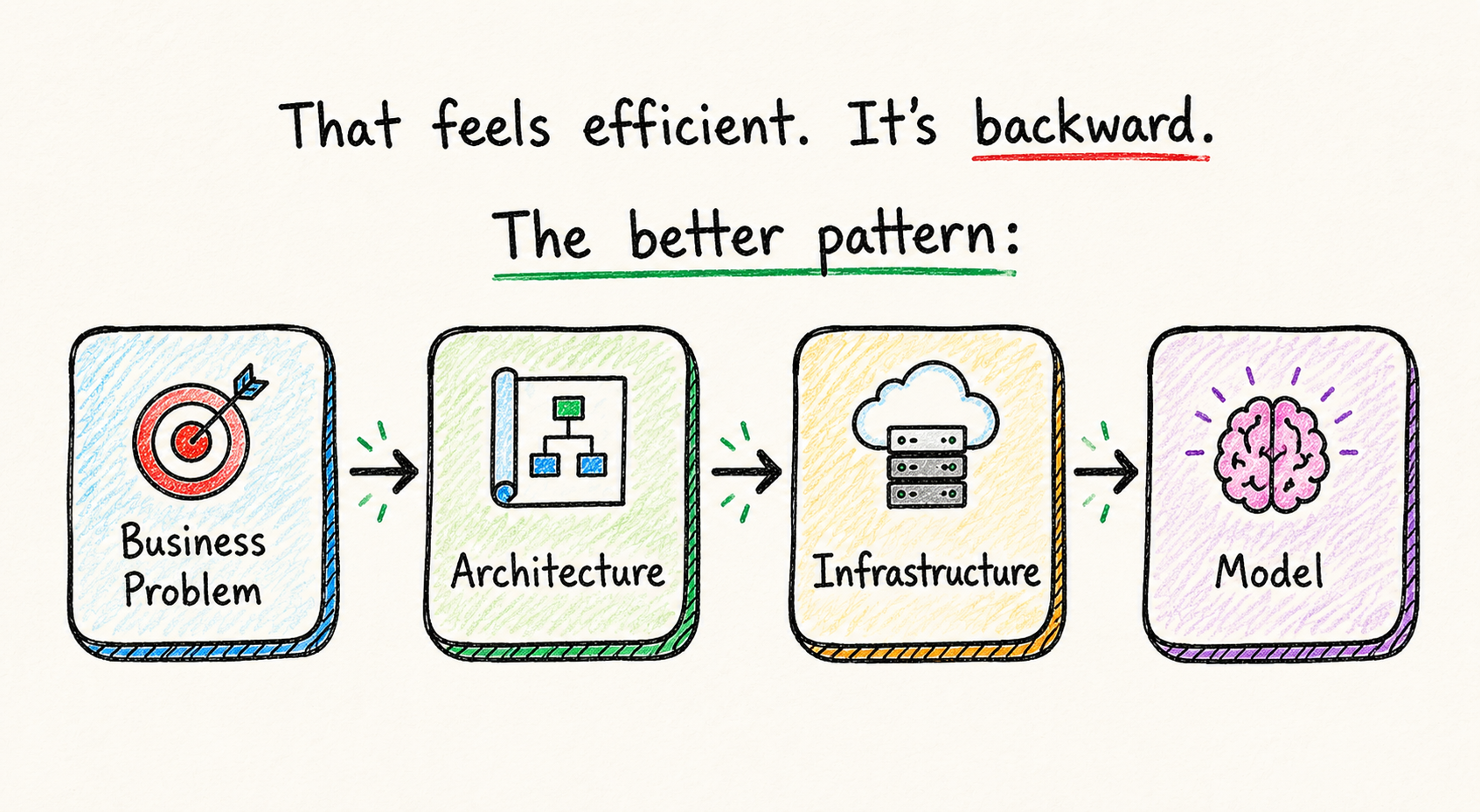
The model still matters. It just stops carrying the entire strategy on its back and becomes one layer in a broader system.
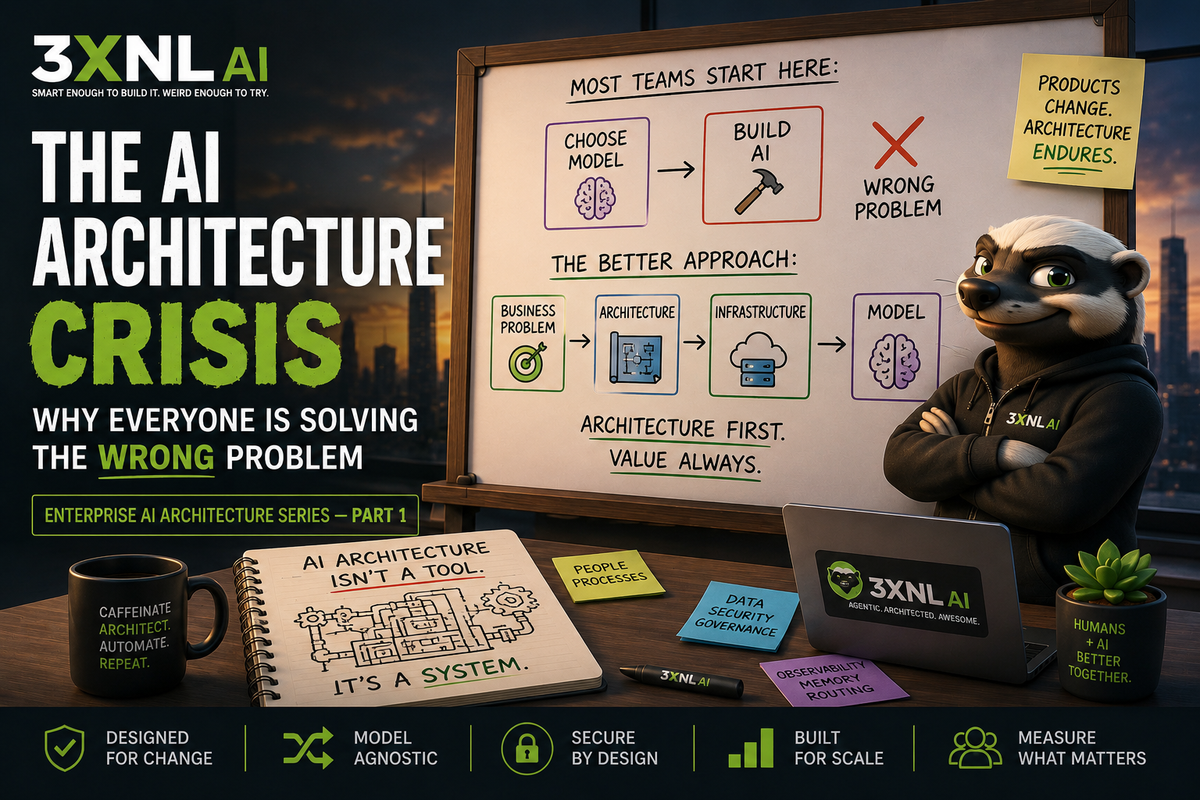
When you start with the model, you ask which is smartest, which is cheapest, which has the highest benchmark, and which is trending. Those questions help you buy. When you start with architecture, you ask what the system must do reliably, what should be reusable, what must be replaceable, what must be governed, and what needs to be measured. Those questions help you build.
Enterprises need both sets. They need them in that order, but almost nobody runs them that way.
Why the Wrong Question Keeps Winning
Because the environment is engineered to produce it.
Consider what presses on a decision-maker simultaneously: a relentless stream of benchmark headlines framed as revolutions, social amplification that rewards drama over durability, fear of missing out weaponized into procurement urgency, vendor marketing that reframes ordinary software as transformational, "AI washing" that slaps the label on things that were always just automation, and the reflexive insistence that everything is now agentic.
Technologies move predictably through a hype cycle: inflated expectations, a fall into disillusionment, and only later a plateau of genuinely productive use. AI hasn't escaped that pattern. It's compressing it.
This surfaces the mismatch at the center of this whole problem.
Enterprise adoption runs on a slower clock than enterprise attention.
The feed operates in hours. Your organization operates on both a quarterly and a fiscal-year basis. Procurement, security review, integration, change management, and training all run on the slow clock. Model releases run on the fast clock. When you let the fast clock drive decisions that live on the slow clock, you don't get agility. You get whiplash, and you pay for it in rework.
Architecture Principle: Never redesign your enterprise because the internet had a good Tuesday.
Models Are Becoming Commodities
We have watched this movie before.
Databases. Your choice of database was once a defining, almost religious decision. Today, for most workloads, the database is dependable plumbing, and the interesting engineering happens above it.
Hypervisors. The virtualization layer was a battleground, and then it became invisible infrastructure. Nobody builds a business identity around which hypervisor they run.
Cloud. Containers. Operating systems. Same arc, every time.
The pattern is consistent enough to be treated as a working law: as a component matures, competition shifts away from the component and toward everything surrounding it. The thing itself commoditizes. Differentiation migrates to the architecture built around it.
AI models are early in exactly this arc. Every model, from every provider, is trending in the same four directions: larger in capability, cheaper to run, faster to respond, and easier to replace.
The economics make it concrete. Epoch AI measured annual inference price declines ranging from 9x to 900x, depending on the capability milestone you track. Stanford's 2025 AI Index found that the cost of querying at GPT-3.5-equivalent performance fell from about $20 per million tokens in November 2022 to roughly $0.07 by October 2024, a 280-fold collapse. a16z, which coined the term "LLMflation" for the phenomenon, estimates the ongoing decline at 10x per year, outpacing the historical cost curves of PC compute and dotcom-era bandwidth.
Now, the part that the commoditization crowd skips.
That 900x figure is the ceiling of the range, not the middle, and it applies mostly to older non-reasoning models. Pricing at the actual frontier has been far more stable. A recent price-performance analysis found the cost of running frontier-level evaluation has risen roughly 18x per year, because extracting marginal capability now burns vastly more inference per answer.
Both things are true simultaneously, and the tension between them is the most useful fact in this article. Last year's frontier collapsed in price. This year's frontier stays expensive. That gap is permanent, and it renews itself annually.
So the honest version of "models are commoditizing" is narrower and considerably more actionable:
The capability you needed last year is becoming free. The capability you want this year remains costly.
An organization that routes most of its traffic to the collapsing tier and reserves the expensive tier for work that genuinely requires it captures the full benefit of that curve. An organization that standardized on one model captures none of it, and pays frontier prices for tasks a commodity model settled eighteen months ago. That isn't a procurement decision. It's a routing decision, and routing is architecture.
What's established here, and what isn't:
- Fact: Inference costs at a fixed capability level have fallen dramatically and consistently.
- Fact: Release cadence has accelerated across every major lab.
- Fact: Frontier-tier costs have not followed that curve, and by some measures have moved the other way.
- Observation: Capabilities that were premium and scarce last year are now near-free and abundant.
- Prediction: The trajectory continues, the commodity tier keeps expanding, and the frontier stays expensive.
- Opinion: The commoditization is already far enough along that any strategy premised on a durable model advantage is a strategy premised on a rounding error.
When a resource gets cheaper, faster, and more interchangeable every quarter, building your strategy on picking the single best one is like building a house on a conveyor belt.
The winner isn't the smartest model. The winner is the architecture that can adopt tomorrow's smartest model.
Architecture Outlives Products
The discipline you need here already exists in your stack. You just haven't pointed it at AI yet.
Nobody re-architects their network because a vendor shipped a faster switch. Nobody rebuilds a storage strategy around a single new drive. Nobody redesigns an application platform because one processor generation has gotten faster. In every mature domain, we learned to separate durable design from disposable components. The switch changes, and the network architecture endures. The CPU changes, and the system design endures.
Architecture evolves on a slower, more deliberate clock than the products that plug into it.
That isn't a weakness. That's the point.
The test for any AI design decision fits on a sticky note:
- Good architecture assumes change and absorbs it gracefully.
- Bad architecture assumes stability and shatters when the ground moves.
Most enterprise AI today is being built on the assumption of stability, on the premise that the currently chosen model is a fixed point. That assumption has a shelf life of roughly 50 days.
The Hidden Cost: AI Technical Debt
It doesn't arrive as a failure. It arrives as success, repeated carelessly.
AI Technical Debt: the accumulation of design decisions that make future AI adoption slower, riskier, and more expensive.
You already understand technical debt in software. This is the same disease with a shorter incubation period, because the underlying components change so much more often.
It's almost never one bad decision. It's a thousand reasonable ones:
- Prompts hard-coded directly into application logic.
- Deep coupling to one vendor's specific API shape.
- Model-specific quirks baked into business logic.
- No abstraction layer between application and model.
- No routing, so every request goes to one place, forever.
- No observability, so nobody can see what the system actually does.
- The same prompt was copied and pasted across a dozen projects.
- "Shadow AI," where teams quietly wire in their own tools with no oversight.
- Business rules are smuggled inside prompts, where no engineer will ever find them.
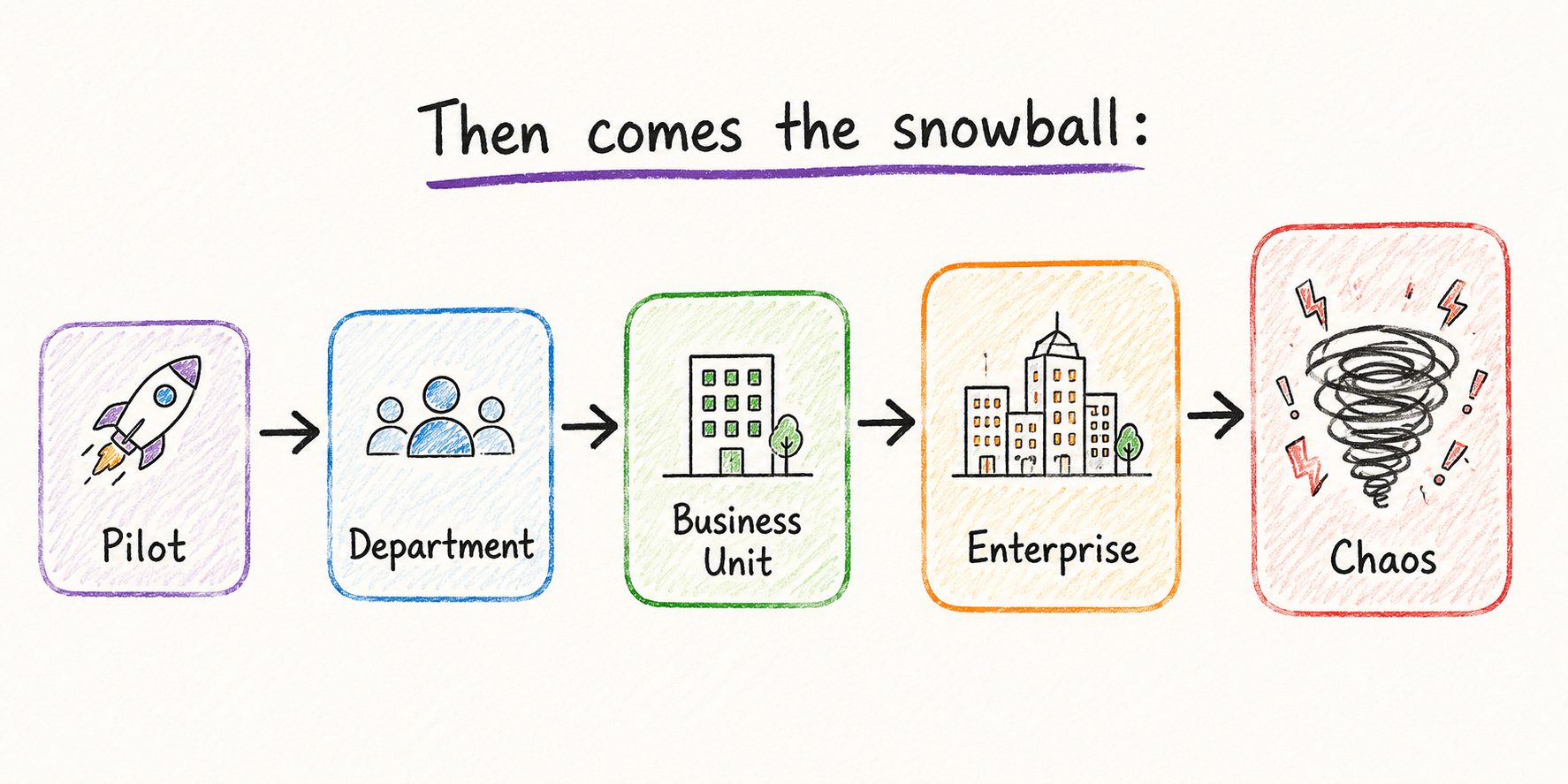
The first demo succeeds brilliantly, which is precisely the problem. The second project copies it. The third duplicates the copy. Each team hard-codes its own model, prompts, and assumptions. By project ten, nobody in the organization can explain how AI works across the company, what it costs, or what would break if a provider raised prices or retired an endpoint.
The debt didn't come from choosing the wrong model. It came from building as though the choice were permanent.
Four Stages of Enterprise AI Maturity
Not every organization sits in the same place. What follows is a maturity ladder based on patterns I keep encountering rather than formal research, so treat it as experience, not evidence. It's useful mostly because it tells you what your next problem will be.
Level 1: Experimenting. Employees use public chat interfaces. Developers use coding assistants. Nobody governs anything. Genuine energy, zero coordination. Everyone starts here, and the danger isn't being here. It's staying here while telling the board you've "adopted AI."
Level 2: Pilots. Departments build point solutions. Customer service creates a knowledge assistant, legal tests, and contract review, and some of it works impressively well. That's the trap. Reuse stays minimal, every win is a private island, and the successes are precisely what convince everyone the approach is working. This is where technical debt compounds fastest. It's also where most enterprises are sitting right now.
Level 3: Platform Thinking. The organization admits it needs shared foundations. Shared infrastructure appears, shared governance emerges, reusable patterns start displacing one-off builds. The internal question shifts from "how do we build an AI app" to "how do we plug into the AI platform."
Level 4: Architecture First. AI becomes an enterprise capability. Models are deliberately replaceable. Governance, infrastructure, and business value scales, because new capabilities arrive without rebuilding everything beneath them.
Four questions locate you on that ladder faster than any assessment framework:
- Can a new team ship an AI feature without re-solving routing, logging, and governance from scratch? (Level 3+)
- If your primary provider doubled its price tomorrow, could you switch in days rather than quarters? (Level 4)
- Can you see, in one place, what every AI system in your company is doing and what it costs? (Level 3+)
- Is "which model?" a configuration change rather than a re-architecture? (Level 4)
Every "no" is a rung you haven't climbed and a place debt is quietly accruing.
What separates the top of that ladder from the bottom isn't model quality. Every level has access to the same models. It's the system around them.
So What Is AI Architecture?
AI Architecture is the collection of systems, processes, and design decisions that allow an organization to safely, reliably, and repeatedly create business value using AI.
Note what that sentence doesn't contain. No model. No vendor. No benchmark. Because:
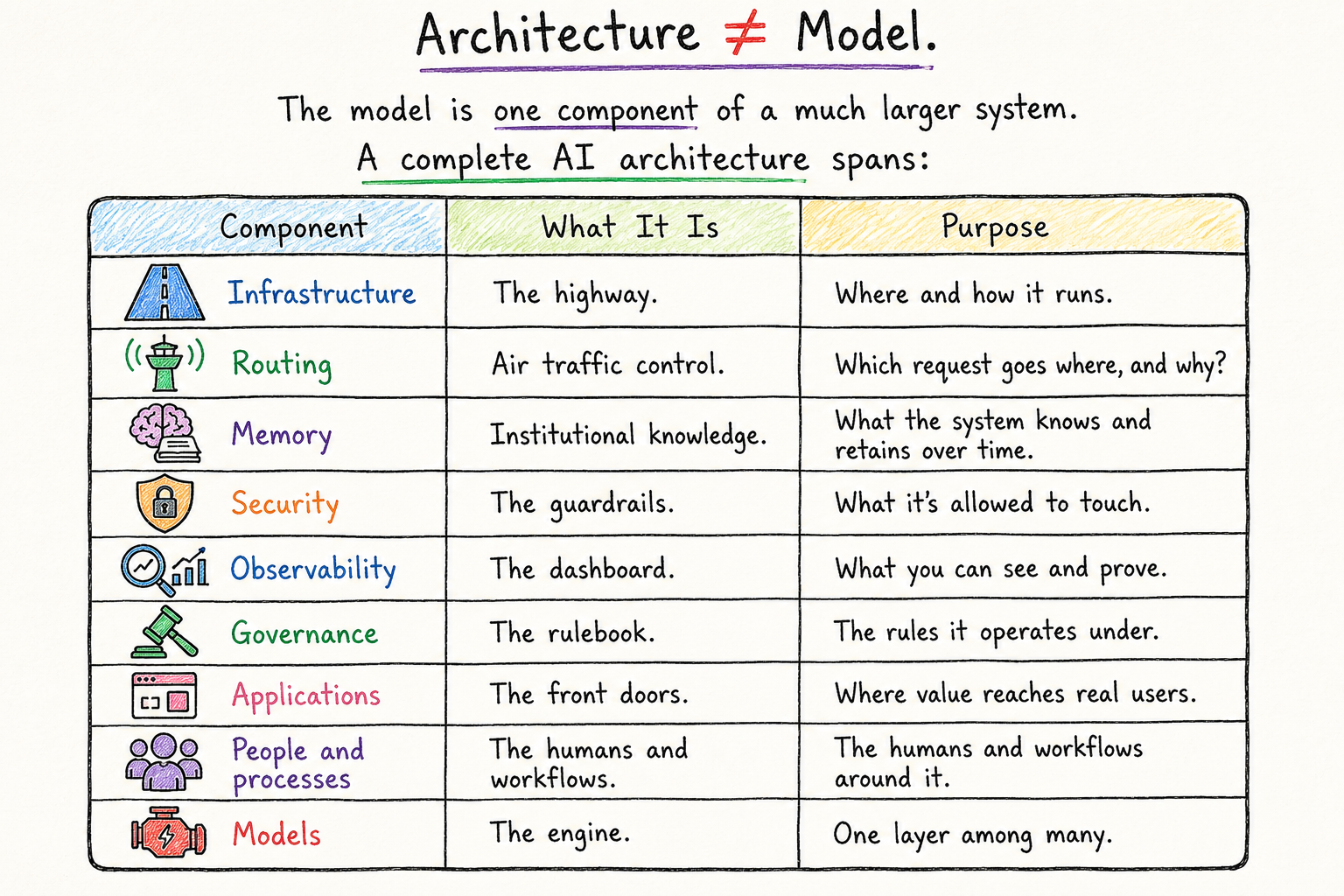
And nobody buys a car for the engine alone. Nobody replaces the car when a better engine ships. The engine is built to be serviced, upgraded, and swapped because the vehicle is what endures.
Enterprise AI Is a Capability, Not a Project
Software projects end. They have launch dates, final releases, and maintenance phases.
Capabilities don't.
Networking is a capability. Identity is a capability. Cloud is a capability. Observability is a capability. AI is becoming the next one.
Treat AI as a project, and you optimize for completion. Treat it as a capability, and you optimize for evolution. If AI is a project, success is a demo. If AI is a capability, success is a growing portfolio of safe, valuable, observable, maintainable AI-enabled workflows, where each investment makes the next one cheaper.
That is what architecture buys you. That is why it matters more than the thing everyone is arguing about on Tuesday morning.
The Forces Are Converging
Four things are happening at once, and they compound.
Model releases keep accelerating, with the monthly cadence of major releases roughly quadrupling since 2023.
Costs keep bifurcating. The commodity tier collapses by factors of 9x to hundreds per year, while the frontier holds its price, widening the gap between what you're paying and what you could be paying every month you don't look.
Open models keep closing the capability gap, which turns "swap the model" from a slide into an operation someone can actually run.
And enterprises keep moving from experimentation toward production, where industry commentary increasingly identifies governance, orchestration, and architecture as the real bottleneck rather than raw model capability.
Add agentic systems and hybrid deployments on top, and single-model applications become multi-model systems that require architecture simply to function.
Hold two facts together. Models are becoming better, cheaper, and more frequent at the same time. The instinct is to conclude that model choice, therefore matters more.
The opposite is true.
The faster models improve, the more valuable the architecture becomes.
Here's the practical form of that claim, and it's the one metric I'd put on an executive dashboard tomorrow. Every benchmark measures the model. Only one number measures you: how long it takes your organization to replace one model with another. Call it your switch time. It's the only benchmark that doesn't expire in 50 days, and almost nobody is tracking it.
What You're Actually Choosing
The companies that win this won't be the ones holding better models. Access is the one thing nobody has a monopoly on for long. That's what commoditization means.
They'll win because they built better systems. When the next breakthrough model arrives, and at one every 50 days, it absolutely will, good architecture lets you adopt it in an afternoon. Bad architecture makes you rebuild everything.
The rest of this series builds that architecture layer by layer. Not a product list. Not a benchmark recap. A durable mental model that outlives whichever vendors happen to dominate the year you read it.
So stop asking which model to choose.
You were never choosing a model. You were choosing how often you'd have to choose again.
Architecture Principle: Design for replacement.
Common Mistake: Choosing a vendor before designing an architecture.
Myth: "The best model wins."
Enterprise Takeaway: Every architecture decision should assume today's best model won't remain the best.
Questions to Sit With
- If your primary AI provider disappeared tomorrow, how long would it take your organization to recover?
- Is your AI strategy centered on a vendor or on an architecture?
- Which parts of your current AI environment are easiest to replace? Which are hardest, and why?
- Where is AI technical debt already accumulating in your organization?
- What architectural capability would deliver the greatest long-term value if you built it today?
Next in the Series — Part 2
The Model Layer: Designing for Constant Change
The industry treats the model as the destination. It's an interchangeable engine, and as we've just seen, it isn't even one engine. It's a price-performance spectrum you're supposed to be moving across constantly.
Next time we take the model layer apart: why the most important design decision isn't which model you choose but whether you can change it without rebuilding everything around it, and what it takes to get your switch time down from quarters to an afternoon.
Sources
Release cadence
- AI Release Tracker — Analytics: https://aireleasetracker.com/analytics
- Business Insider (cites AI Release Tracker on quadrupled monthly cadence): https://www.businessinsider.com/ai-coding-tools-software-engineers-workplace-paralysis-2026-6
- a16z — Welcome to LLMflation (10x annual decline, vs. PC compute and dotcom bandwidth): https://a16z.com/llmflation-llm-inference-cost/
- Cottier et al. — The Price of Progress: Price, Performance and the Future of AI (frontier evaluation cost rising ~18x/yr): https://arxiv.org/html/2511.23455v2
- Introl — Inference Unit Economics: https://introl.com/blog/inference-unit-economics-true-cost-per-million-tokens-guide