Your AI Pilot Saved Time. Where Did the Money Go?


Enterprise AI has a method - It just isn't a blueprint
Lately, the question I get most is some version of this: how do I use AI to save my business money? It comes from friends, from peers, and from random people the moment they find out I work in IT. I have started answering with a number (and it’s not 42).
In McKinsey's 2026 global survey, 80 percent of respondents said AI had improved their individual productivity. Only 37 percent attributed any positive effect on earnings before interest and taxes to it.
The people got faster. The income statement did not get the memo.
The AI demo went beautifully.
A model summarized the contract, drafted the customer response, assembled the meeting notes, and produced a presentation before lunch. The executive team nodded. Someone used the word "transformational." Nobody was physically harmed by the slide deck.
Then the project entered the enterprise.
The contract lived in one repository. The customer history lived in another. Half the notes were stale, and access rights had accumulated over years like sediment in a neglected aquarium.
The draft still required three approvals. The employee who supposedly saved an hour used most of it checking whether the model had invented a discount.
This is the less cinematic part of enterprise AI: the point where a capable model collides with an actual company.
And the collision is showing up in the numbers. Beyond the 80 and the 37, just 6 percent qualified as "AI high performers," meaning they reported at least a 5 percent EBIT contribution and described the value as significant.
Those are self-reported survey results, not audited corporate accounts. They do not prove that any particular management practice caused the difference.
But they reveal the question every enterprise AI program eventually has to answer:
How does a local improvement become an organizational result?
The Thesis - Narrow Enough to Lose
The honest answer is narrower, and more defensible, than "the model doesn't matter" or "workflow redesign solves everything."
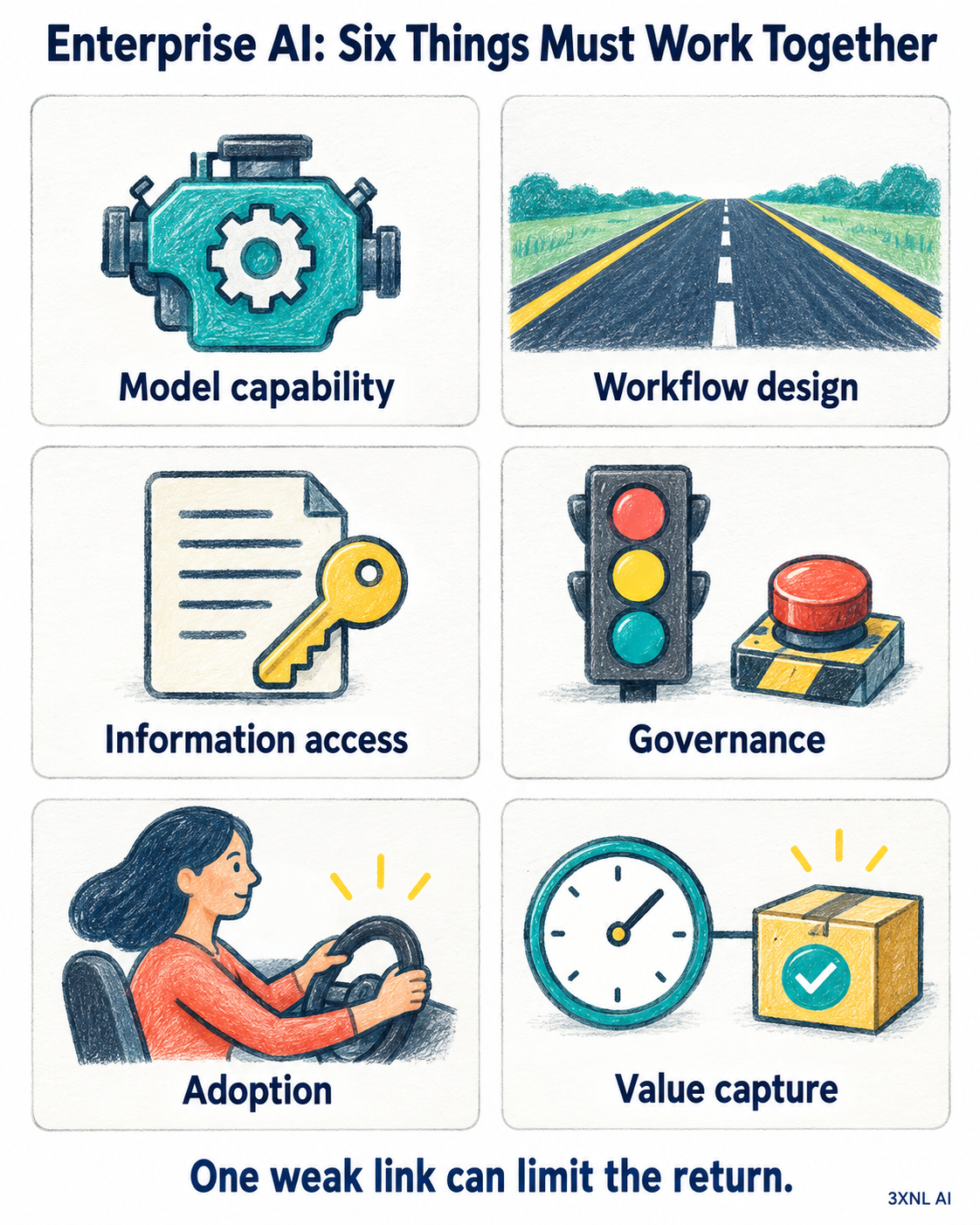
Enterprise AI creates measurable value when model capability, workflow design, information access, governance, adoption, and value capture operate as complements. A weakness in any one of them can limit the return from the rest.
Six things have to work together, and any one of them can cap the other five.
This is not a universal blueprint. It is a testable operating hypothesis.
If a capable model is inserted into a suitable workflow, receives the right information, operates within workable controls, gets used by the intended people, and still fails to improve the agreed business outcome after its full costs are counted, the hypothesis has failed for that use case.
No incense. No blaming "culture." No request for another eighteen-month transformation program.
The Model Still Has to Be Good
Organizational design does not make model limitations disappear.
A system cannot reliably perform work that exceeds its reasoning, perception, context, or tool-use capabilities. A beautifully redesigned process wrapped around an unreliable model is still unreliable, just with better project management.
But model capability is rarely the only constraint.
Consider an AI assistant that prepares account briefings. In a demonstration, the task looks straightforward: read the customer record, summarize recent activity, identify risks, and suggest the next conversation.
Inside a real business, "the customer record" may include a CRM entry, an account manager's private notes, a support history, a pricing exception in a contract, and an obsolete presentation that refuses to die. The system must identify authoritative sources, distinguish current facts from stale ones, respect access restrictions, and deliver the result before the salesperson has already joined the call.
The model's ability to summarize is necessary. It is not sufficient.
The same logic applies to the workflow surrounding it. If the assistant drafts a proposal in ten minutes but the proposal waits six days for legal approval, the company accelerated a task without necessarily accelerating the business.
A faster engine does not fix a traffic jam. But neither does reorganizing the road around an engine that stalls every third mile.
The Evidence Is Real. It Is Also Narrow.
The strongest evidence for AI productivity gains remains specific, not universal.
A peer-reviewed study published in The Quarterly Journal of Economics examined the staggered introduction of a generative AI assistant to 5,172 customer-support agents. Access to the assistant increased issues resolved per hour by 15 percent on average, with the largest gains among less-experienced and lower-skilled workers. The most experienced workers saw much smaller gains and slight declines in some quality measures.
That is meaningful evidence. It is also evidence from one company, one occupation, and a relatively structured form of work.
It does not establish that every sales team, legal department, engineering group, or field-service operation should plug 15 percent into a spreadsheet and begin spending the imaginary proceeds.
Even within the study, human-AI interaction was messy. On average, agents followed the assistant's recommendations only 38 percent of the time. Sometimes people ignored useful advice. Sometimes skepticism was probably healthy.
Either way, "human in the loop" was not a magic reliability spell.
The broader survey evidence is similarly suggestive rather than causal. In McKinsey's 2026 survey, nearly three-quarters of self-described high performers reported fundamentally redesigning workflows, compared with roughly one-quarter of other respondents.
That association supports the workflow thesis. It does not prove it. Well-managed firms may be better at both redesigning work and selecting valuable AI projects. Successful AI programs may also create the political permission to redesign workflows after the value becomes visible.
The honest interpretation is not "workflow redesign causes AI profits."
It is: workflow redesign is a plausible complement to AI capability, and it deserves to be tested as one.
Stop Asking Where You Can Use AI
The fashionable enterprise question is still, "Where can we use AI?" The better question is, "What currently limits the outcome we care about?"
If customer cases sit untouched for two days, faster drafting may help. If cases move quickly but require repeated corrections, quality may be the real constraint. If a service technician spends half the visit locating documentation, information retrieval may matter more than generation.
And if demand is fixed and the team has no backlog, time savings may have little economic value unless staffing, service levels, or the work mix changes.
This distinction prevents a common failure: optimizing whatever the model can easily demonstrate rather than what the business actually needs.
A useful pilot therefore starts with five statements:
- The outcome: What should improve? Resolution rate, cycle time, conversion, error frequency, customer retention, avoided hiring, or something else?
- The constraint: What currently limits that outcome?
- The intervention: Which part of the work will AI change?
- The counterfactual: What would probably happen without the intervention?
- The failure threshold: What result would cause the company to stop, redesign, or reject the approach?
Run your current pilot through those five. Notice which one is blank.
That last statement matters. Without it, you can reclassify every weak result as "learning," and every stalled pilot can become a permanent resident of the innovation lab.
Translation: a pilot with no failure threshold is not a pilot. It is a subscription.
Small Scope - Serious Test
"Start small" is good advice until it becomes a synonym for "give a few people a chatbot and hope something interesting happens."
Small should describe the scope of the workflow, not the seriousness of the test.
Imagine a field-service team dealing with a recurring equipment fault. A bounded intervention might:
- Retrieve the correct service documentation.
- Assemble the equipment's maintenance history.
- Recommend a troubleshooting sequence.
- Ask the technician to verify high-risk steps.
- Record the confirmed resolution in the existing service system.
- Measure whether first-visit resolution improves without increasing safety incidents or repeat work.
This forms a complete loop: information, recommendation, judgment, action, feedback, and measurement.
It also creates a real opportunity to fail. If resolution rates do not improve, if verification takes longer than manual diagnosis, or if integration and inference costs exceed the benefit, the company has learned something more useful than "employees liked the demo."
A cross-functional team is usually necessary because no single group owns the whole system:
- The business owner understands the outcome.
- Domain specialists understand exceptions.
- Engineers understand integration and failure recovery.
- Security, legal, and risk teams understand the boundaries.
- Frontline users know which elegant process diagram will collapse before Tuesday afternoon.
That does not mean every project needs a committee with matching tote bags. It means the people who can observe the problem should sit close to the people who can change the system.
Build Access - Not a Bigger Swamp
Enterprise AI needs reliable access to information. It doesn't need a bigger pile.
The raw material comes in two kinds: structured data (inventory levels, invoice amounts, customer identifiers) and unstructured information such as contracts, manuals, emails, presentations, and policy documents.
The simplistic response is to copy everything into one enormous repository and declare the company "AI-ready." This often produces a more modern data swamp: larger, shinier, and still full of things nobody trusts.
The opposite extreme is equally dangerous. Querying dozens of source systems in real time can create latency, broken dependencies, inconsistent permissions, and a thicket of point-to-point integrations that becomes its own expensive product.
The correct principle is not "centralize nothing." It is:
Make authoritative information consistently accessible through an architecture whose latency, permissions, semantics, provenance, and maintenance costs are understood.
Depending on the workflow, that architecture may include a warehouse, lakehouse, knowledge graph, retrieval index, semantic layer, direct APIs, or some unholy but documented combination of them.
For a shipment assistant, the important questions are practical:
- Which system owns the promised delivery date?
- What does "available inventory" mean in this business?
- How fresh must the data be?
- Can the system distinguish a signed contract from a draft?
- Do source permissions survive indexing and retrieval?
- Can the answer show where each material fact came from?
- What happens when an API fails, or two systems disagree?
This is not glamorous work. Neither is plumbing, right up until the ceiling starts dripping during the board meeting.
Rent What Works - Price In Moving Day
Vendor dependence is a risk, not a moral failure.
An AI capability embedded in Salesforce, SAP, Microsoft 365, ServiceNow, or another operating platform may be the best answer when the task is contained inside that platform. The vendor already owns the interface, data model, permission system, and workflow hooks. Rebuilding all of that internally in the name of independence can create a bespoke monument to unnecessary suffering.
Custom orchestration becomes more defensible when the workflow crosses multiple systems, the process is strategically distinctive, switching costs can be contained, or the organization needs controls the vendor cannot provide.
The decision should be based on explicit trade-offs:
- Time to value.
- Process differentiation.
- Data portability.
- Permission fidelity.
- Observability and evaluation.
- Integration and maintenance burden.
- Model and vendor substitution.
- Exit cost.
Architectural independence does not mean refusing to rent anything.
It means knowing what you rent, what you control, and how expensive moving day will be.
Choose the Least Autonomous Thing That Works
Not every AI system needs to be an agent.
Anthropic distinguishes workflows, where models and tools follow predefined code paths, from agents, where the model dynamically directs its own process and tool use. Its engineering guidance recommends starting with the simplest workable design and adding complexity only when the task requires it, because agentic systems can trade higher latency and cost for flexibility and can compound errors across steps.
For a predictable service process, a controlled sequence may be preferable. For an open-ended investigation where the correct path cannot be known in advance, an agent may be justified.
This is not a permanent law of nature. Model capabilities will change. A workflow architecture that makes sense in 2026 may look like a steam-powered fax machine a year later.
The practical rule is therefore temporary and empirical:
Use the least autonomous design that meets the task's performance requirements. Re-test that choice as capabilities, costs, and risks change.
An agent is not a promotion awarded to a workflow for good behavior. It is a different control system with different economics.
Governance Is a Permission System, Not a Binder
Governance is often presented as a policy binder placed gently on top of a moving train.
Operational governance is more specific. It defines what the system may access, what it may do, how its behavior is observed, which failures trigger escalation, and who can stop it.
NIST's AI Risk Management Framework organizes this work into four functions: Govern, Map, Measure, and Manage. Its generative AI profile also recommends explicit performance thresholds, deployment approval criteria, monitoring, and documented responses to high-priority risks.
For the field-service example, useful boundaries would include:
- Which equipment and customer records the system may access.
- Whether it may recommend or execute an action.
- Which actions always require qualified approval.
- What evidence must accompany a recommendation.
- When the system must stop and escalate.
- How actions are logged and reconstructed.
- How the capability is disabled or rolled back.
Ask who can stop your system today. If finding out takes a meeting, you have your answer.
Permissions should expand only when evidence supports expansion. But governance must also have a budget and a service level.
If every low-risk change requires six committees and a lunar alignment, governance has become the bottleneck it was supposed to manage.
"Human in the Loop" Is a Phrase, Not a Control
"Human in the loop" is not a control unless the loop has a design.
Which human? Reviewing what? Against which evidence? With how much time, expertise, independence, and authority?
A systematic review of 35 peer-reviewed studies involving 19,774 participants found that trust, task complexity, professional expertise, AI literacy, verification demands, and explanation design shape automation bias. Explanations alone do not reliably eliminate over-reliance; in some cases, they can reinforce misplaced confidence.
Showing a reviewer the model's reasoning can increase trust, even when it is wrong.
Human review also has an economic limit.
If a qualified lawyer spends forty minutes validating an AI-generated clause that would have taken thirty minutes to draft, the system has not automated the work. It has changed the job title from "writer" to "AI detective."
A viable design must therefore measure:
- The time and expertise required for review.
- The errors reviewers catch and miss.
- Whether review quality declines at higher volume.
- Whether sampled audits can replace universal review.
- Whether deterministic checks can verify part of the output.
- Whether the cost of residual errors remains acceptable.
When verification costs approach original production costs and the consequences of undetected error are high, the use case may not be ready for automation. The right answer may be decision support, narrower scope, stronger automated checks, or no deployment at all.
That last option is underrated.
Payroll Does Not Care About Your Ten Minutes
Time saved is still not money.
Suppose an assistant saves 200 employees ten minutes each day. The spreadsheet will happily convert that into annual labor savings. Payroll will remain stubbornly unimpressed.
Small fragments of saved time do not automatically combine into usable capacity. The organization needs a capture mechanism: more cases handled, lower overtime, avoided hiring, shorter customer wait times, fewer errors, higher conversion, or deliberate reassignment to higher-value work.
Without such a mechanism, time saved may still improve employee experience. That is a legitimate benefit. It is simply not the same thing as cash.
Name the capture mechanism for your flagship use case. One sentence, no adjectives.
The productivity J-curve offers another warning against simplistic measurement. Research on general-purpose technologies argues that firms often make substantial, poorly measured investments in process redesign, new business models, and human capital before the benefits appear in conventional productivity statistics.
That means weak short-term EBIT results can support more than one explanation:
- The organization failed to redesign work.
- The model was not capable enough.
- The selected use case had little inherent value.
- Benefits exist but appear in quality, retention, risk reduction, or avoided cost rather than current EBIT.
- The company is still paying the upfront cost of complementary investment.
- The project simply failed.
A serious measurement system must distinguish among them.
Count the Whole Bill
AI business cases tend to count software licenses and then become strangely incurious.
A full accounting has eight lines.
The result
- Business outcome: Resolution, conversion, cycle time, forecast accuracy, avoided loss, or another workflow-specific result.
- Quality and risk: Errors, repeat work, escalations, incidents, customer outcomes, and residual risk.
- Adoption: Whether intended users employ the capability in the actual process.
- Captured value: What the organization actually does with improved capacity, speed, quality, or risk.
The bill
- Model operations: Inference, retrieval, embeddings, evaluation runs, monitoring, and model substitution.
- Integration: APIs, identity mapping, permission enforcement, data pipelines, and semantic maintenance.
- Human labor: Review, exception handling, training, support, and governance.
- Reliability: Latency, downtime, tool failures, recovery, and business continuity.
This scorecard should be owned jointly. Technology teams remain responsible for technical performance and reliability. Business owners remain responsible for the operational outcome and the mechanism that converts improvement into value.
Neither can substitute for the other.
If It Cannot Fail, It Is Not a Test
The operating-discipline theory becomes useful only when a company can prove it wrong.
For each workflow, define a claim such as:
Giving service agents an AI assistant with access to approved documentation will improve first-contact resolution by at least 8 percent within six months, without increasing repeat contacts, compliance incidents, or fully loaded cost per resolved case.
Then compare performance against a credible baseline or matched control group. Track adoption, quality, review costs, integration costs, and downstream effects. Predefine the minimum result required to continue.
The theory should be rejected or revised for that workflow if:
- The model cannot meet the required reliability.
- Employees do not use it despite adequate design and training.
- Verification erases the productivity gain.
- Improvements do not survive beyond a narrow pilot.
- The full cost exceeds the captured benefit.
- A simpler point tool or vendor feature produces the same result more cheaply.
- The expected benefit does not appear within a timeframe justified by the investment thesis.
This prevents "operating discipline" from becoming a corporate horoscope: vague enough to explain everything after it happens.
The Upside Comes With a Tab
The opportunity is larger than efficiency. So is the exposure.
The customer-support study suggests AI can help less-experienced workers improve more quickly, potentially changing training, staffing, and access to organizational knowledge. Better systems may also reduce wait times, improve consistency, and let experts spend more time on genuinely difficult work.
But the same pattern creates risks:
- If firms use AI mainly to replace expertise with cheaper labor, they may weaken the pipeline that produces future experts.
- If employees stop practicing foundational skills, short-term augmentation can become long-term deskilling.
- If reviewers learn to trust polished output, human oversight can decay into ceremonial clicking.
There is also a timing risk. A company can move so cautiously that competitors learn faster. It can also move so aggressively that customers become involuntary members of the quality-assurance team.
The answer is not maximum speed or maximum restraint.
It is short learning cycles, bounded consequences, honest accounting, and clear permission to stop.
Run a Portfolio, Not a Ritual
Enterprise AI is neither a software purchase nor an organizational-development retreat with a chatbot attached. It is a portfolio of operating experiments.
Some will succeed because a capable model removes a genuine constraint. Some will succeed because a vendor quietly embeds AI into software people already use. Some will require redesign across systems, roles, incentives, and approvals. Others will fail because the work was never valuable enough to justify the machinery.
The goal is not to force every use case through the same transformation ritual.
The goal is to identify which combination of capability, process, data, control, adoption, and capture produces a better result, and to stop when it does not.
Write It in Pencil
No universal sequence of AI purchases and milestones guarantees transformation. However, there is a method.
Find the constraint. Define the outcome. Choose the simplest capable system. Connect it to authoritative information.
Set testable permissions. Count verification and integration. Decide how value will be captured. Establish the result that would prove the idea wrong.
Then run the test.
The organizations that do this well will not avoid every bad investment. Nobody does. They will simply discover their mistakes sooner, learn which practices genuinely generalize, and expand autonomy because the evidence supports it, not because the product name includes "agent."
Write the enterprise AI playbook in pencil.
The scorecard should not.
AI Transparency Note: I wrote this article at a coffee shop that also serves beer, tacos, and cheese curds, a bold writing environment. AI tools helped refine clarity, grammar, structure, and readability, particularly after several beverages. The ideas, opinions, conclusions, and final editorial decisions are my own. I generated the images with AI using prompts I reviewed and approved.
Further Reading
McKinsey & Company, The State of AI: Global Survey 2026.
McKinsey & Company, AI is changing work. Now it has to change the organization.
McKinsey & Company, The state of AI in 2026: On the road to ROI (PDF), August 2026.
NIST, AI Risk Management Framework (AI RMF), NIST AI Resource Center.
NIST, Artificial Intelligence Risk Management Framework: Generative Artificial Intelligence Profile, NIST AI 600-1.
Giuseppe Romeo and Daniela Conti, Exploring automation bias in human-AI collaboration: a review and implications for explainable AI, AI & Society.
Becker Friedman Institute, The Productivity J-Curve: How Intangibles Complement General Purpose Technologies.