The Introduction to the Enterprise AI Architecture Series
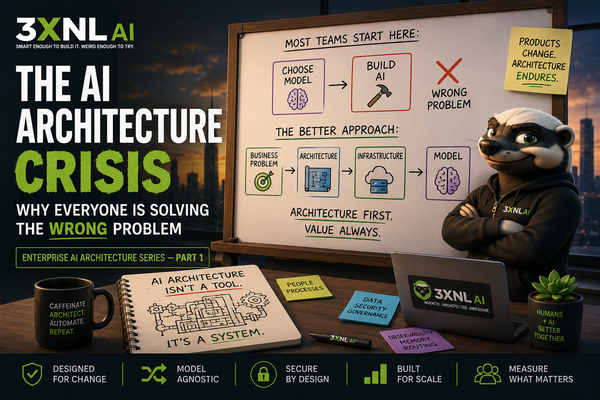
Enterprises keep asking, "Which model should we use?" That's the wrong question. And it's costing you more than you realize.

Enterprises keep asking, "Which model should we use?" That's the wrong question. And it's costing you more than you realize.
Six Weeks Ago, You Had a Strategy. Congratulations.
Six weeks ago, every AI consultant in your inbox told you to standardize on one model. Today they're pushing another. Six weeks from now, a third.
Exhausting? Sure. Also accelerating.
Google, OpenAI, and Anthropic have compressed their major model release cycles to roughly 50 days on average. Down from about 130 days just a few years ago. Google alone has shipped a new flagship or sub-version every month or so since December: Gemini 3, then 3 Pro, then 3.1 Pro, then 3.1 Flash Lite, then Gemma 4.
OpenAI went from GPT-5 to GPT-5.5 in six iterations between August 2025 and April 2026. Anthropic, Meta, Mistral, DeepSeek, Qwen, GLM, Kimi, and a growing cast of Chinese labs are all shipping on overlapping, unpredictable timelines.
Meanwhile, you're in a conference room debating which one to build on.
You're picking a favorite horse in a race where they swap the horses mid-lap.
That question was already wrong a year ago. Today it's actively dangerous. This article, the first in a series, explains why. And it hands you something better than a vendor shortlist: stop treating enterprise AI as a product decision. It's an architecture problem.
Every Tuesday, The Rules Change
The AI industry doesn't have a stability problem. It has a velocity problem wearing a stability problem's clothes.
Here's the roster an enterprise architect had to seriously evaluate as of mid-2026:
- GPT-5.5 and its five predecessors
- Claude Opus 4.7 and 4.8
- Gemini 3.1 and Gemma 4
- Grok 4.3
- DeepSeek V4, Qwen 3, GLM 5.2, Kimi K2.6, and newer entrants like Fable
Open-weight releases in April 2026 alone (Llama 4, Qwen 3, Gemma 3n/4, DeepSeek V4, GLM 5.2, Mistral Large 3) triggered measurable shifts in enterprise and developer adoption almost overnight.
That is not a vendor landscape you evaluate once a year and revisit at renewal. It's a market where the "best" model has a shelf life measured in weeks.
Anthropic shipped Opus 4.7 just 70 days after Opus 4.6, citing meaningful gains in coding, vision, and self-verification. The kind of jump that used to justify a full generational rename and a keynote with fog machines.
Waiting for things to settle? They're not going to settle. The pace is accelerating.
You're Optimizing The Most Disposable Part Of The Stack
"What model should we use?" feels like the natural place to start. It's also the fastest route to being stuck.
Here's the thing: the model is the single least stable component in your entire AI stack. It's also where you're spending the bulk of your attention, your procurement cycles, and roughly eleven hours of meetings per quarter.
You're bolting your architecture to the one part guaranteed to be replaced.
The questions that actually matter get shoved to the bottom of the agenda. Here's the short list:
- How do we design so a model swap doesn't require rebuilding everything downstream?
- How do we avoid vendor lock-in when the "winning" vendor changes every quarter?
- How do we evaluate models continuously rather than through a single, heroic bake-off that nobody repeats?
- How do we secure AI systems that touch sensitive data and take autonomous actions?
- How do we actually operate this stuff at scale, day to day, without a hero engineer?
None of those are about which logo sits on the API. They're about structure. Structure is exactly what almost nobody has built.
Networking Already Solved This. In 1984.
This isn't a new problem. Computing has been here before, leaving behind a blueprint.
In the 1970s and early 1980s, networks were multiplying fast, and every vendor had its own way of doing things. IBM's SNA. DEC's DECnet. Novell's IPX. Plus a scattering of proprietary protocols that refused to talk to each other.
Buying into one ecosystem meant genuine lock-in: your hardware, your protocols, and your future upgrade path all shackled to one company's roadmap. Sound familiar?
Beginning in 1977, the International Organization for Standardization set out to fix it. By 1984, it had published the OSI Reference Model: seven layers, from physical cabling up to the applications people actually used.
And here's the kicker. OSI didn't win by picking the winning protocol. It didn't pick the winning protocol at all. TCP/IP, not OSI's own suite, ended up running the actual plumbing of the Internet.
OSI won anyway. It won by giving engineers, vendors, and buyers a shared vocabulary. A way to say "that's a Layer 3 problem" and have the entire room understand you, regardless of whose hardware was in the rack.
To be clear: this is an analogy about the value of shared structure. It is not a pitch for a standards body to bless an official "OSI of AI." Nobody's proposing a committee. Nobody wants a committee.
Same Mess. New Logos.
Swap "IBM, DEC, and Novell" for "OpenAI, Anthropic, and Google," and the parallel gets uncomfortably precise.
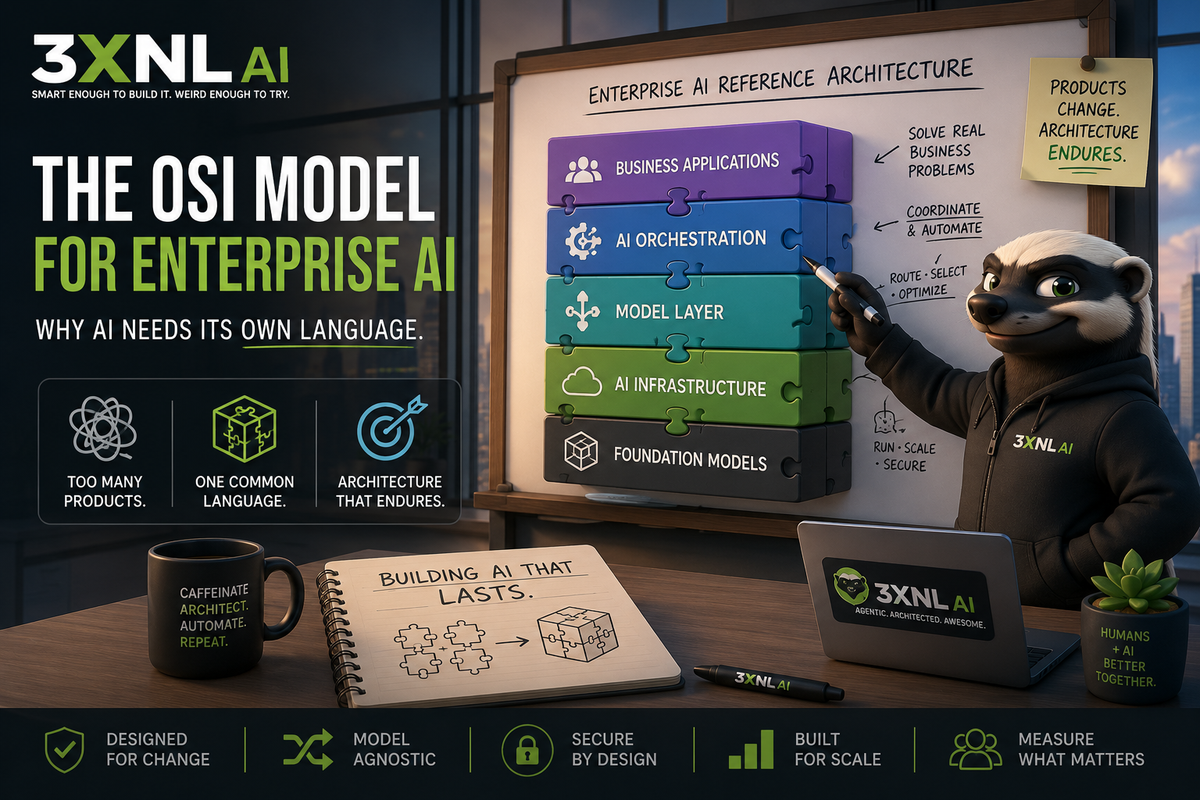
Today's landscape has foundation models, infrastructure providers, memory systems, routing layers, agent frameworks, orchestration tools, and business applications. Almost nobody agrees on what any of those words mean.
One vendor's "agent" is another vendor's "workflow." "Memory" might mean a vector database, a fine-tuned adapter, or a context window trick, depending entirely on who's holding the slide deck. "Routing" could mean load balancing across providers or selecting which sub-agent handles a task.
The terminology is fragmented because the category boundaries were never drawn. We're all confidently using words nobody defined.
The damage compounds at every level:
- Procurement can't compare vendors apples-to-apples, so it compares logos and discounts
- Security can't map controls to layers that don't exist on anyone's diagram
- Engineering rebuilds the same integration logic every time a new model gets bolted on
Three departments. One shared vocabulary problem. No one is willing to say it out loud in the steering committee.
Layers, Not Logos
The fix isn't a better model-selection process. It's a different mental model entirely.
Instead of evaluating products, think in layers: discrete categories of capability that remain conceptually stable even as the tools that fill them churn.
Instead of picking vendors, think in capabilities: what does this piece of the stack actually need to do, independent of who's doing it.
Instead of chasing benchmarks, think in architecture: how do the pieces connect, and what detonates when one gets swapped out?
That last point is the thesis this entire series is built on:
Products evolve. Architecture endures.
A model you adopt today will be obsolete, in relative terms, within months. An architecture that treats the model as a replaceable component can outlast a dozen model generations without a rebuild.
One of those requires discipline. The other requires a purchase order. Guess which one your organization is better at.
Introducing The Enterprise AI Reference Architecture (It's Not Finished. That's The Point.)
This series is going to build something, layer by layer: an Enterprise AI Reference Architecture.
Upfront about scope, because you've been burned before. This is not a finished blueprint being unveiled today. It's not locking into a specific number of layers before the reasoning behind them is established.
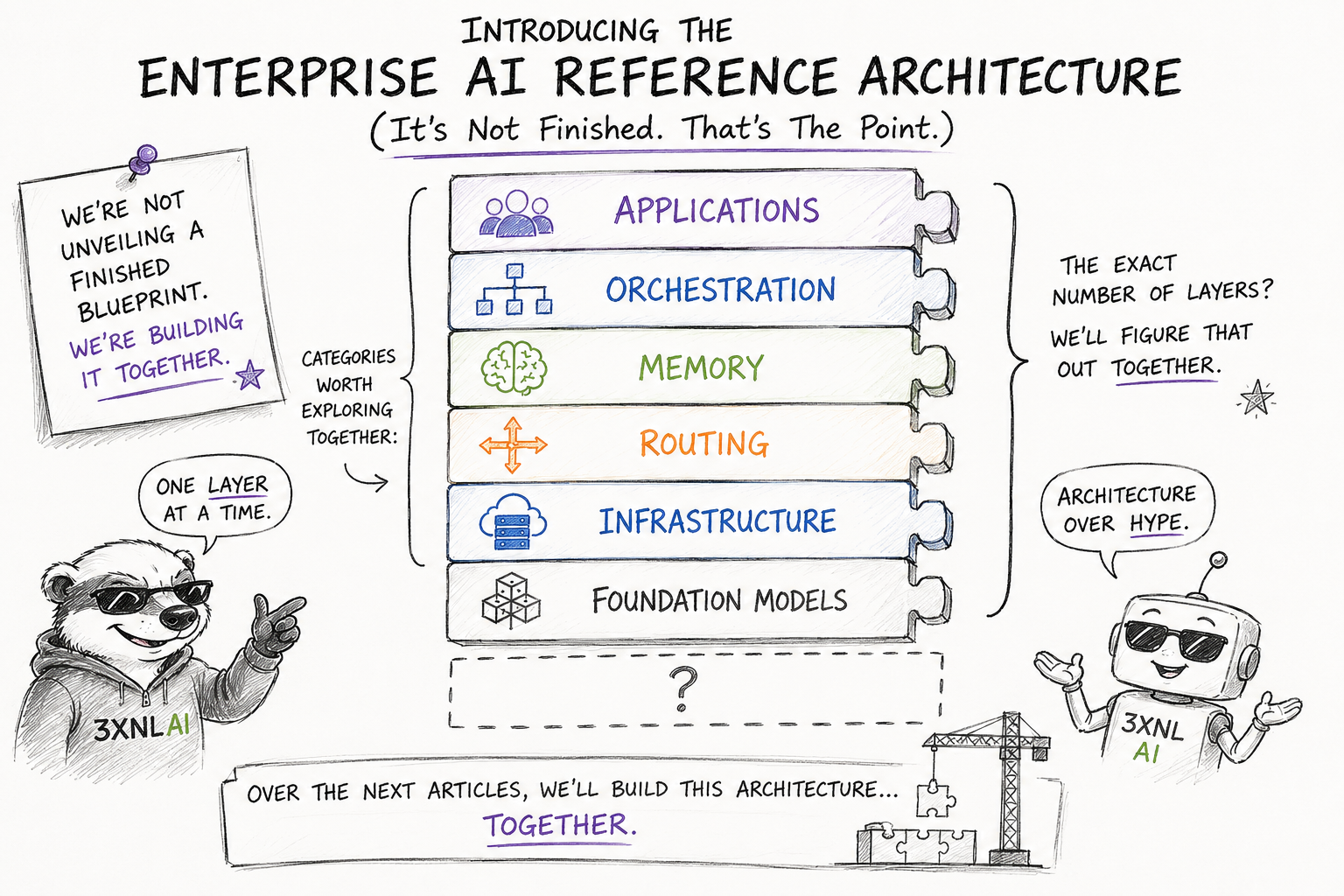
Working examples, not commitments. Some may merge, split, or get renamed as the series progresses and real enterprise patterns get tested against the framework.
Yes, that's less satisfying than a laminated poster with seven boxes. Frameworks that arrive fully formed usually arrive from a marketing department.
How To Read This Series
Each article focuses on exactly one architectural concept. No attempting the whole stack in a single heroic post.
Every piece will include:
- Plain-English explanations of the concept
- Real enterprise examples of it in practice
- Decision frameworks for evaluating options
- Architecture diagrams
- Common mistakes teams make at that layer
- The tradeoffs involved in different approaches
- Pointed questions to bring back to your own team
What you won't find: hype, benchmark worship, or vendor marketing dressed up as analysis.
Who This Is For
Primary: enterprise architects, infrastructure leaders, IT directors, security leaders, developers, technical managers, and AI enthusiasts who want to move past surface-level takes.
Secondary: anyone trying to understand how the pieces of modern AI systems actually fit together, even without a technical background.
What This Series Is Not
Let's review what you're not getting:
- Not the "best" AI model. Instead, architecture that outlasts any single model.
- Not prompt engineering tips. Instead: decision-making frameworks.
- Not top 10 AI tool roundups. Instead: long-term structural thinking.
- Not the latest benchmark rankings. Instead: tradeoff analysis.
- Not vendor reviews. Instead: vendor-neutral design principles.
If you came for a leaderboard, there are approximately nine hundred newsletters ready to serve you this week.
The Journey Ahead
The series starts at the foundation, literally: the model layer. Then it moves one layer upward at a time. Memory, routing, orchestration, agents, and governance each get dedicated treatment before the picture comes together.
The goal is that you feel like you're constructing something over the coming weeks. Not consuming a stack of disconnected blog posts. Each article should slot into the last one like a puzzle piece, until the full architecture is visible.
Why You Should Care Before Your Next Renewal Date
This isn't an academic exercise.
Organizations that architect around one model's quirks are quietly accumulating technical debt. They won't notice it until the exact moment they need to switch: during a price hike, a security incident, or when a competitor's model improves dramatically overnight.
Major model updates now arrive roughly every 50 days among the top three labs alone. Open-weight alternatives are closing the capability gap fast enough to shift real developer adoption within a single month.
"We'll deal with it when we need to switch" is no longer a posture. It's a countdown.
Reality check: the stakes show up in boring places. Contract renewals. Security audits. Engineering roadmaps. All of them get harder when nobody in the building can confidently say which breaks if a given model vanishes tomorrow.
Teams that separated orchestration, memory, and application logic from any single model's API can adopt a better model in days.
Teams that didn't are looking at months of rework. In a market moving this fast, months are the difference between leading and catching up.
What's Coming Next
Expect the release pace to keep compressing rather than stabilizing, at least through the current competitive cycle among the major labs.
Open-weight models are becoming credible substitutes for proprietary ones on real enterprise workloads. Which means the "safe default" of sticking with one big-name vendor is eroding.
Nobody ever got fired for choosing the incumbent. That's still technically true. It's just getting more expensive.
As the series progresses, watch the framework's categories sharpen. The model layer article will draw the clearest line yet between what should be swappable and what should be durable.
Closing
Networking got easier once everyone agreed on a shared language for the pieces, even after the "official" protocol was beaten by a scrappier alternative.
Cloud computing became easier once computing, networking, and storage were separated into distinct concerns rather than a tangled bundle.
Containers became easier once images became the standard unit rather than a bespoke deployment ritual.
AI is standing at that same fork right now.
The organizations that come out ahead won't be the ones that picked the smartest model this quarter. That title changes hands every 50 days anyway.
They'll be the ones who built an architecture good enough not to care.
Next article: The Model Layer: Designing for Constant Change
Models will keep changing every few weeks. Your architecture shouldn't.
Questions To Ruin Your Next Team Meeting
- If GPT disappeared tomorrow, what would break in your organization?
- Are you building around a product or around an architecture?
- How difficult would it be to replace your primary AI model today: a day, a month, or a year?
- Which decisions in your AI strategy are architectural versus merely tactical?
- If a materially better model is launched next Tuesday, could you actually adopt it? And how fast?
Architecture Principle: Products evolve. Architecture endures. Every design decision in this series gets tested against that principle first.
Common Myth: "We just need to pick the right model, and we're set." In a market shipping major updates every 50 days, no model choice stays right for long. The architecture around it determines how painful each transition becomes.
References
- AI Big Three Cut New-Model Release Cycles to About 50 Days ...
- AI model release news, 2026: the timeline, and the part that ...
- AI model updates: every major 2026 release, year to date ...
- Research how enterprise and developer communities are ...
- Best Open Source LLM 2026: DeepSeek, Kimi, Qwen Ranked
- OSI model
- How the OSI Model Standardized Networking in the 1980s - LinkedIn
- OSI: The Internet That Wasn't