What Is Odysseus? PewDiePie's Self-Hosted AI, and How It Stacks Up Against Hermes and OpenClaw
Learn how Odysseus compares to today’s leading AI workspaces. We cover its origins, architecture, key features, pros and cons, and support for Claude, OpenAI, Ollama, and local models to help you choose wisely.

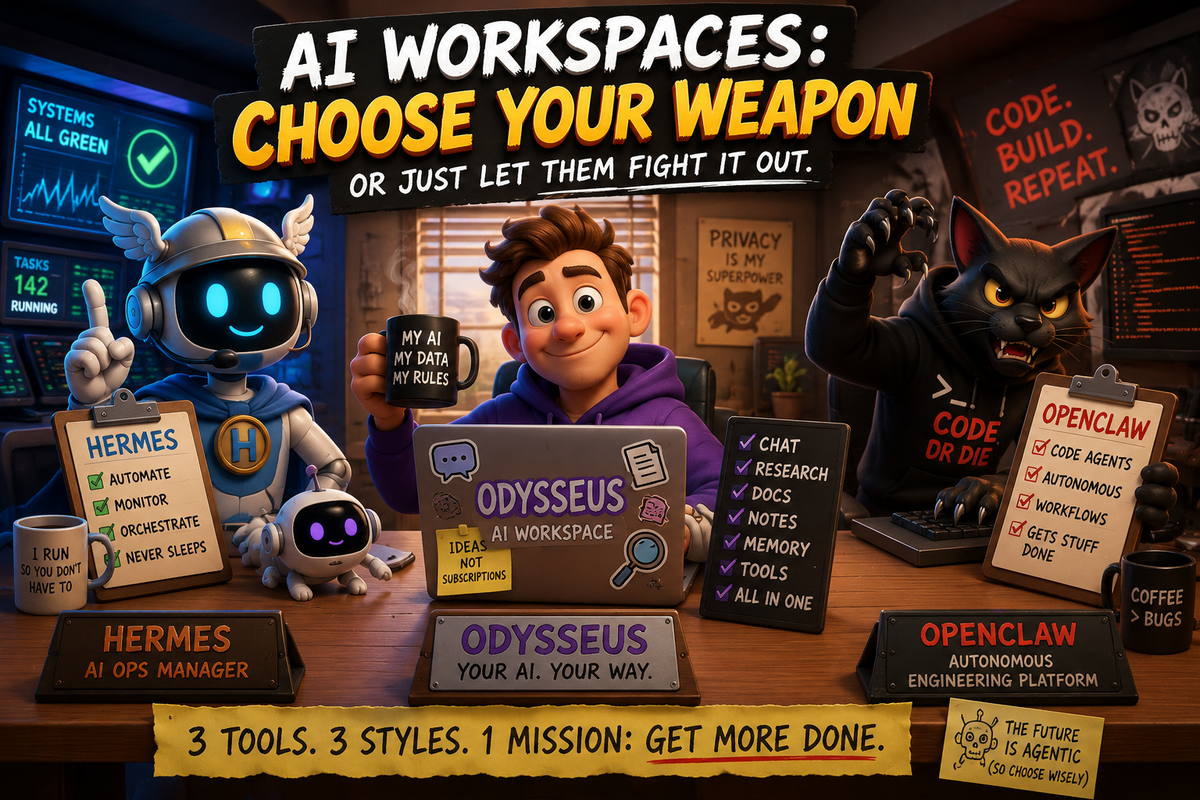
PewDiePie just dragged local AI into the mainstream. The real question isn't "which one wins." It's "which one is built for the way you actually work?"
Six Months Ago, Nobody Cared. Now Everybody's Asking.
Self-hosting your own AI went from a basement hobby to a mainstream question in about four weeks. You can thank a YouTuber.
Six months ago, running your own AI model was a weekend project for people who genuinely enjoy compiling llama.cpp at 2 a.m. Everyone else quietly paid twenty bucks a month to OpenAI and never once wondered where their data actually went.
Then the biggest YouTuber on the planet blew the doors off.
On June 1, 2026, Felix Kjellberg, better known as PewDiePie, with 110 million-plus subscribers, open-sourced a project called Odysseus. It rocketed past 70,000 GitHub stars within weeks. By early July, it was north of 80,000. Suddenly, millions of people who'd never questioned their AI subscription started asking a genuinely dangerous one:
"Wait... should I just run my own AI?"
Here's the part that should make you sit up.
The world's biggest YouTuber may end up being the person who drags local AI out of the home lab basement and into your living room. That's a weird sentence. It's also true.
But Odysseus didn't land in a vacuum. It arrived inside a fast-forming category, next to two very different projects, Hermes and OpenClaw, that are solving overlapping problems in almost opposite ways.
Understand the difference between these three, and you understand where AI tooling is actually heading.
What this is not: a "which one wins" cage match.
What this actually is: a map of the next shape of AI software.
And if you write code, run a business, handle sensitive data, or just resent the idea of your entire digital life flowing through someone else's monthly subscription, this is worth your attention right now.
Why This Whole Category Exists (Or: How "Weird Hobby" Became "Movement")
Four forces collided at once. Together, they turned "run your own AI" from oddity into a legitimate product category.
Before we pit these tools against each other, one question deserves an answer: why did self-hosting AI go from fringe to front-page in barely a year?
It wasn't one thing. It was four, stacked.
1. Local models got genuinely good. This is the big one.
For years, the honest answer to "can a local model replace a frontier model for real work?" was "not really." By 2026, for a huge chunk of everyday tasks, that flipped to "yeah, actually." Open-weight families like Qwen, Llama, and Mistral, paired with better quantization (GGUF, FP8, AWQ), mean a single decent GPU, or even an Apple Silicon Mac, can run something that feels like a top-tier model from two years ago.
PewDiePie, running open models on a rig stuffed with modded GPUs, said his local setup felt "exactly like ChatGPT, but much faster."
2. Subscription fatigue is real. You're paying for a chat assistant, a coding assistant, an image tool, and a research add-on.
At some point, "just run it myself" stops looking like paranoia and starts looking like arithmetic, especially if the hardware's already humming in the next room.
3. Privacy stopped being abstract. The Odysseus pitch is blunt: your hardware, your data, no accounts, no telemetry, no tracking.
For anyone uneasy about handing over their emails, half-formed ideas, and private documents, that is the whole product.
4. The plumbing finally showed up: MCP. The Model Context Protocol, introduced by Anthropic in late 2024, is the quiet hero of this entire story.
Think of MCP as USB-C for AI: one standard way for any model to plug into any tool, file, or data source instead of every app inventing its own janky integration.
The numbers are absurd:
- Roughly 2 million to about 97 million monthly SDK downloads in around 16 months
- Adopted by OpenAI, Google, and Microsoft
- Handed to a Linux Foundation fund in December 2025
MCP is why a self-hosted app can suddenly talk to your calendar, your browser, and your shell without a bespoke plugin for each one. It's what turned isolated chatbots into agents that actually do things.
Reality check:
Security is the top adoption blocker. Reportedly about a quarter of public MCP servers ship with no authentication at all. The plumbing works. Some of it also leaks.
Stack those four forces together, and you don't get a better chatbot. You get a brand-new category: the self-hosted AI workspace and three flagship interpretations of what that should mean.
The Real Shift: From Chatbots to Three Different "Shapes"
The first wave of AI was a smart intern behind a glass wall. The next wave hands the intern a keyring.
The first consumer AI was dead simple: type in a box, get a reply. Impressive. Also limited.
A chatbot is a brilliant intern behind a pane of glass. It can advise, draft, and explain. But until it can touch your actual files, tools, calendar, and inbox, it's stuck being advisory.
That era is ending.
And the smartest way to understand these three tools is not as three versions of the same thing. There are three different shapes of what personal AI is becoming:
- The Workspace is a private office where you sit down. (Odysseus)
- Mission Control an operations console for agents doing real work. (Hermes)
- The Gateway Assistant an always-on agent living in the channels you already use. (OpenClaw)
Those aren't the same purchasing decision. They're not even the same idea.
Let's take them one at a time.
Odysseus: The Private AI Office
Odysseus is the ChatGPT experience rebuilt to run entirely on your hardware, with your data, and nobody's subscription.
The cleanest mental model: Odysseus is the self-hosted version of the experience you get from ChatGPT or Claude, "but with more jank and fun," as its own README cheerfully admits, running on your machine, with your data.
What makes it more than a chat clone is what it crams into a single docker compose up. This isn't a chatbot. It's an entire knowledge-work suite:
- Chat with any model locally (vLLM, llama.cpp, Ollama) or via an API (OpenAI, Anthropic via OpenRouter, even GitHub Copilot), switchable at runtime.
- Agent mode that hands the model real tools: shell, files, web, memory, skills, plus any MCP server you wire in.
- Cookbook arguably the standout. It scans your actual GPU, scores 270+ open-weight models for quality, speed, and fit for your specific hardware down to the quantization format, then downloads and serves with one click. Most local-AI setups ignore the hardware layer entirely. Odysseus treats it as first-class.
- Deep Research a real agentic pipeline (adapted from Alibaba's Tongyi DeepResearch) that plans, generates queries, searches in parallel across SearXNG/Brave/Tavily, extracts and synthesizes iteratively, decides on its own when to stop, then formats a visual report.
- Compare blind, side-by-side model testing so you judge outputs on quality rather than brand loyalty.
- Memory & Skills via ChromaDB with hybrid vector + keyword retrieval, so the workspace learns your context over time.
- Email (IMAP/SMTP with AI triage and drafts), Calendar (CalDAV), Notes & Tasks, a document editor, image editing, and a mobile-ready PWA.
Under the hood: a FastAPI backend, a modular JavaScript front-end, ChromaDB for memory, SearXNG for private search, all orchestrated through Docker Compose with NVIDIA/AMD GPU overlays.
Two design choices reveal surprising maturity for a project born on a livestream.
First, the agent parses fenced code blocks directly from model output and executes them, making it model-agnostic and compatible with local models that have weak native tool support.
Second: external content, such as emails and documents, is injected as "data, not instructions" to blunt prompt-injection attacks.
That's not a rookie move. That's someone who's already thought about what happens when an agent reads a malicious email.
In one line: Odysseus is a personal AI workspace. The ChatGPT-on-your-own-server experience, expanded into a life-management cockpit.
The licensing footnote you actually need to read.
A lot of secondary coverage and plenty of early write-ups call Odysseus "MIT licensed." The live repository currently lists AGPL-3.0-or-later, changed in early June 2026.
Self-hosting at home? This is academic.
Planning to modify Odysseus and expose it as a hosted service? AGPL's copyleft obligations matter enormously.
Always check the repo's currentLICENSEbefore you build a business on top of it.
Odysseus also deserves credit for being loud about security. Its own docs are strict: keep authentication on, keep the localhost bypass off, use secure cookies, and never expose it directly to the public internet without HTTPS and a trusted reverse proxy.
By default, Docker binds everything to 127.0.0.1non-admin users who get no shell, and destructive tools are admin-gated.
Why does this matter? Because an AI workspace with shell access, file access, email, and memory isn't "an app."
It's a privileged control surface. Think of it as handing a very eager assistant a keyring, a laptop, and permission to improvise.
Odysseus vs. Hermes: The Office vs. The Night-Shift Operator
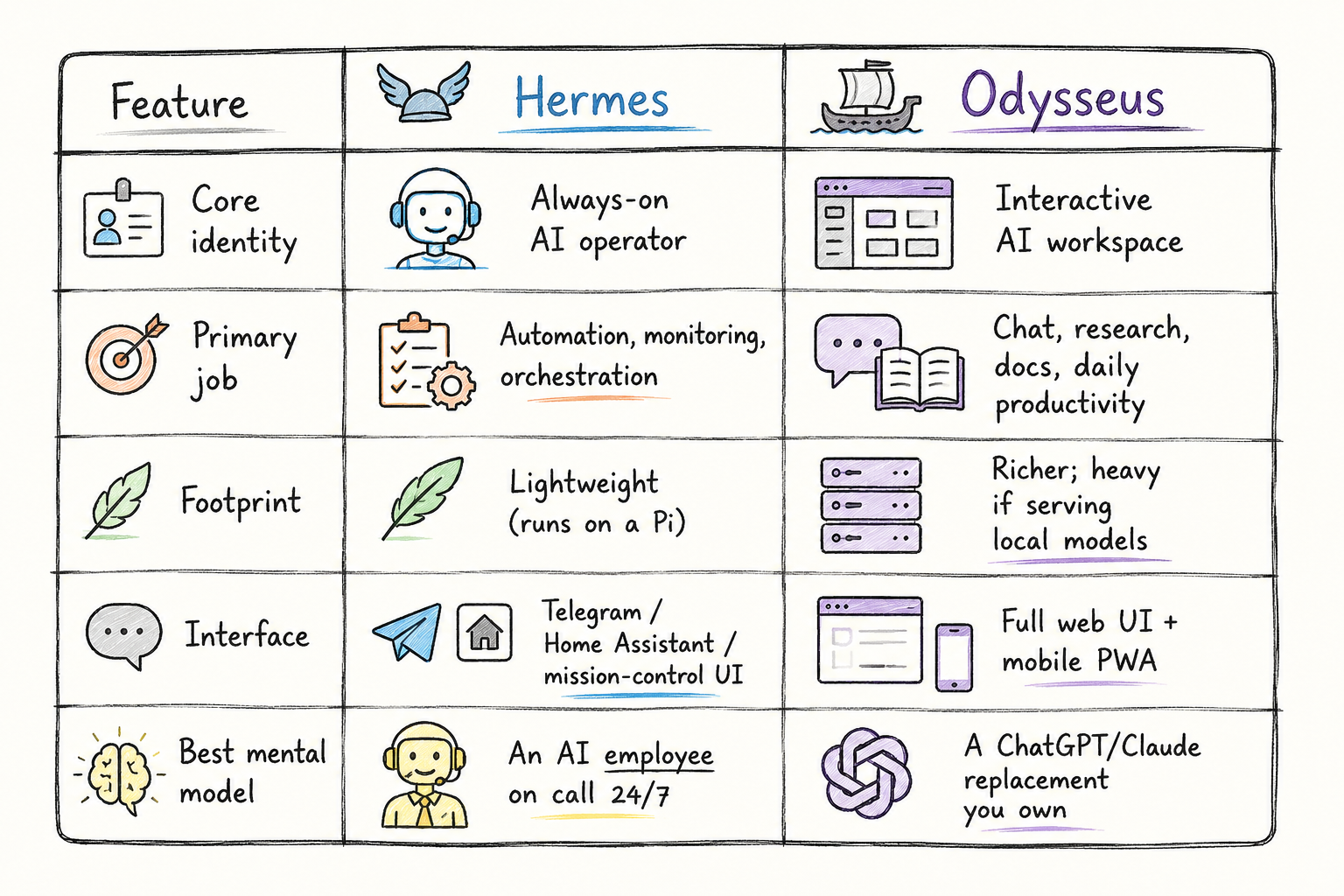
Same self-hosted turf. Opposite philosophy. Odysseus is a workspace you use; Hermes is an operator that runs while you sleep.
Hermes from Nous Research, with the "Hermes Workspace" web UI bolted on top, attacks the problem from the other side. Where Odysseus is a rich workspace you sit down and use, Hermes is built around an always-on agent that runs your infrastructure while you're not looking.
Its natural home is a homelab. Hermes runs happily on a VPS, a NAS, or even a Raspberry Pi, and is reachable via Telegram or Home Assistant, acting as "the brain that ties your services together."
The Workspace UI reinforces the identity marketed as "your AI agent's command center," with:
- Multi-model chat
- A memory browser
- A skills catalog
- An integrated browser terminal
- Real-time tool cards
- A Conductor/Operations layer for orchestrating parallel sub-agents
Same modern primitives as Odysseus tools, MCP, and persistent memory. Pointed at operations instead of knowledge work.
What Hermes is good at:
- Minimal resource needs
- Deep fit with existing self-hosted stacks
- Multi-agent profiles (one agent for leads, one for content, one for client reports no memory crossover)
- A self-improving loop that creates and refines its own skills
- A managed option, for people who want the agent without babysitting a server
What Hermes is not:
It's not where you go for a beautiful research report or a focused writing session. The interaction surface is deliberately thin. By design.
Here's the thing. Neither one is "better."
Odysseus asks: "How do I make my daily AI use private and integrated?"
Hermes asks: "How do I put an autonomous operator inside my infrastructure?"
Different questions. Different tools. Stop trying to make them fight.
Odysseus vs. OpenClaw: The Office vs. The Engineer
This is the most revealing matchup, because OpenClaw is the most philosophically distant of the three and the most dangerous if you get lazy.
OpenClaw is a self-hosted personal AI assistant and autonomous agent framework that became an open-source reference point almost overnight, racking up a GitHub footprint in the hundreds of thousands of stars.
Its defining trait is reach.
Instead of a workspace you visit, OpenClaw runs as a persistent, local-first Gateway, a daemon that answers you on the channels you already use: WhatsApp, Telegram, Slack, Discord, Signal, iMessage, Microsoft Teams, Matrix, and a long list of others.
Pair that with a marketplace of thousands of reusable "skills," voice wake and talk modes, and companion apps, and you've got something closer to an ambient AI service than a desktop tool.
Where OpenClaw shines is doing especially software engineering. Coding agents. Skills. Workflows. Autonomous execution. Controlling your machine from your phone.
It's the tool you reach for when you want an agent that writes code, runs commands, and chains multi-step actions with minimal hand-holding.
Odysseus, by contrast, is built for thinking and organizing: chat, documents, research, notes, memory. Its agent can run a shell and edit files but that capability serves the workspace rather than being the product.
What people imagine:
Two versions of the same self-hosted AI toy.
What actually exists:
- OpenClaw - an autonomous engineer (and always-on assistant) you delegate execution to. Skills-first. Action-first. Developer-first.
- Odysseus - a knowledge worker's cockpit. Context-first. Research-first. Consumer-friendly.
But reach has a price. That price is the attack surface.
OpenClaw agents can execute shell commands, read local files, and browse the web autonomously. The moment you connect an agent with real system access to a public messaging surface like Discord or Telegram, prompt injection stops being theoretical and becomes a live threat.
To OpenClaw's credit, its docs don't pretend otherwise. Inbound DMs are treated as untrusted input, and it ships pairing policies, allowlists, and Docker/SSH sandboxing for non-main sessions.
The rule if you deploy it:
Sandbox it properly. Hide it behind a mesh VPN like Tailscale.
With that discipline in place, OpenClaw is unmatched for complex, cross-platform engineering work.
Without it? You've handed a stranger with root access a phone number. Sleep well.
Under the Hood: The Death of One-Model Thinking
The public still treats AI like a horse race. Serious users have already stopped picking a single horse.
Here's one of the most important trends nobody outside the trenches is talking about: the model is becoming interchangeable.
The public still argues GPT vs. Claude vs. Gemini vs. Llama vs. whatever ships next Tuesday. But for serious users, the future isn't picking one model forever.
It's routing different jobs to different models.
All three tools embrace this:
- Odysseus connects to OpenAI-compatible APIs, Anthropic via OpenRouter, GitHub Copilot, and local servers via Ollama, llama.cpp, and vLLM, all of which are switchable at runtime.
- Hermes supports Anthropic, OpenAI, OpenRouter, Ollama, vLLM, LM Studio, and any OpenAI-compatible endpoint.
- OpenClaw supports many providers while nudging you toward a current flagship you trust.
And the hardware realities deserve plain language, because Odysseus's README is refreshingly honest about them:
- vLLM and SGLang are CUDA/ROCm only. They don't run on macOS. Full stop.
- On Apple Silicon, Docker can't reach the Metal GPU, so you run Odysseus natively and lean on llama.cpp/Ollama for acceleration. MLX-only models aren't served.
- On Windows, the core app runs natively, but local GPU serving of vLLM/SGLang needs Linux or WSL2. Ollama is the path of least resistance. Windows support is clearly less mature than Linux/Docker.
Moving target alert:
The current state of first-class Claude Code and OpenAI Codex integration versus simply calling their APIs is exactly the kind of thing that shifts release to release. The agent is built on the opencode framework and clearly supports Anthropic and OpenAI models. Whether that's deep native workflow integration is a claim with an expiration date. In a project shipping commits daily, treat any specific integration boast as a moving target.
Now, the payoff of interchangeable models. This is the part worth slowing down for.
You ask: "Research this market."
The system quietly breaks it apart:
- Fast local model to parse your notes
- Cloud model for high-quality planning
- Web search for current data
- Local embeddings to search your private docs
- A coding model to build charts
- A writing model for the final memo
- Another model to critique the whole thing
To you, it feels like one assistant. Under the hood, it's a small AI department pretending to be a single friendly face.
That's where this is going.
Where Each One Honestly Falls Short
Most reviews get vague right here. That's usually where they were being paid to. Let's not.
Odysseus's weaknesses flow straight from its strengths.
It's young v1.0 shipped mid-2026 and moving at breakneck speed, which means breaking changes and still-maturing docs. Its ecosystem is smaller and newer than long-established players.
And while the app itself is lightweight, serving local models is genuinely resource-hungry. The flashy demos ran on a multi-GPU monster. At least one hands-on reviewer hit Python environment errors and local-serving trouble even on a capable Mac Studio.
Enterprise features SSO, fine-grained RBAC beyond built-in admin gating, and audit trails are thin next to commercial platforms.
Hermes's limits are the flip side of its minimalism: it's not built for rich interactive research or document work. That's not the job. Judging Hermes on writing polish is like judging a forklift on parallel parking.
OpenClaw's risks are autonomy-shaped:
- A marketplace of thousands of community skills is powerful and a supply-chain attack surface.
- An agent that can execute shell commands off an inbound message demands serious sandboxing discipline.
Three great tools. Three very different ways to shoot yourself in the foot. Know which foot before you start.
Why This Matters and the Security Asterisk Nobody Wants
This movement isn't about saving twenty bucks a month. It's about who owns the machine that runs your intelligence.
If local models are now "good enough" for most tasks, and MCP makes tool integration standard, the economics quietly shift.
A freelancer, a small dev shop, or a privacy-conscious professional can plausibly replace a stack of subscriptions with hardware they already own and keep the data on-premises.
For lawyers, financial analysts, and healthcare workers handling sensitive documents, that's not a nice-to-have. That's the difference between "AI is off-limits for compliance reasons" and "AI is a daily tool."
There's a jobs angle too, and it's more interesting than the usual doom.
AI won't "replace jobs" in one clean sweep. That framing is too blunt to be useful. More likely, AI workspaces change the unit of productivity.
One person with a well-configured system may operate like a small team: coding agents, research agents, charting agents, memo-writing agents, all running in parallel.
Who actually benefits?
Not the people who merely use AI. The people who learn to compose AI systems:
- Knowing when to route a task to a cheap local model
- Knowing when to call a frontier model
- Knowing which tasks are safe to automate
- Knowing which ones need a human in the loop
Now the asterisk. Because self-hosting moves the security burden onto you.
Here's the principle underneath everything:
The more useful an AI assistant becomes, the more dangerous it becomes when misconfigured.
A self-hosted agent with shell access is a far scarier thing than a leaked chatbot password.
This is not a reason to run away from these tools. It's the price of sovereignty. Own the AI, own the responsibility.
The next wave of AI literacy will include a healthy dose of security literacy. That part isn't optional. It just isn't.
What's Coming Next: From Workspace to Personal AI Company
Step back far enough, and three projects, each starting from a different place, are all walking toward the same door.
The trajectory looks like this:
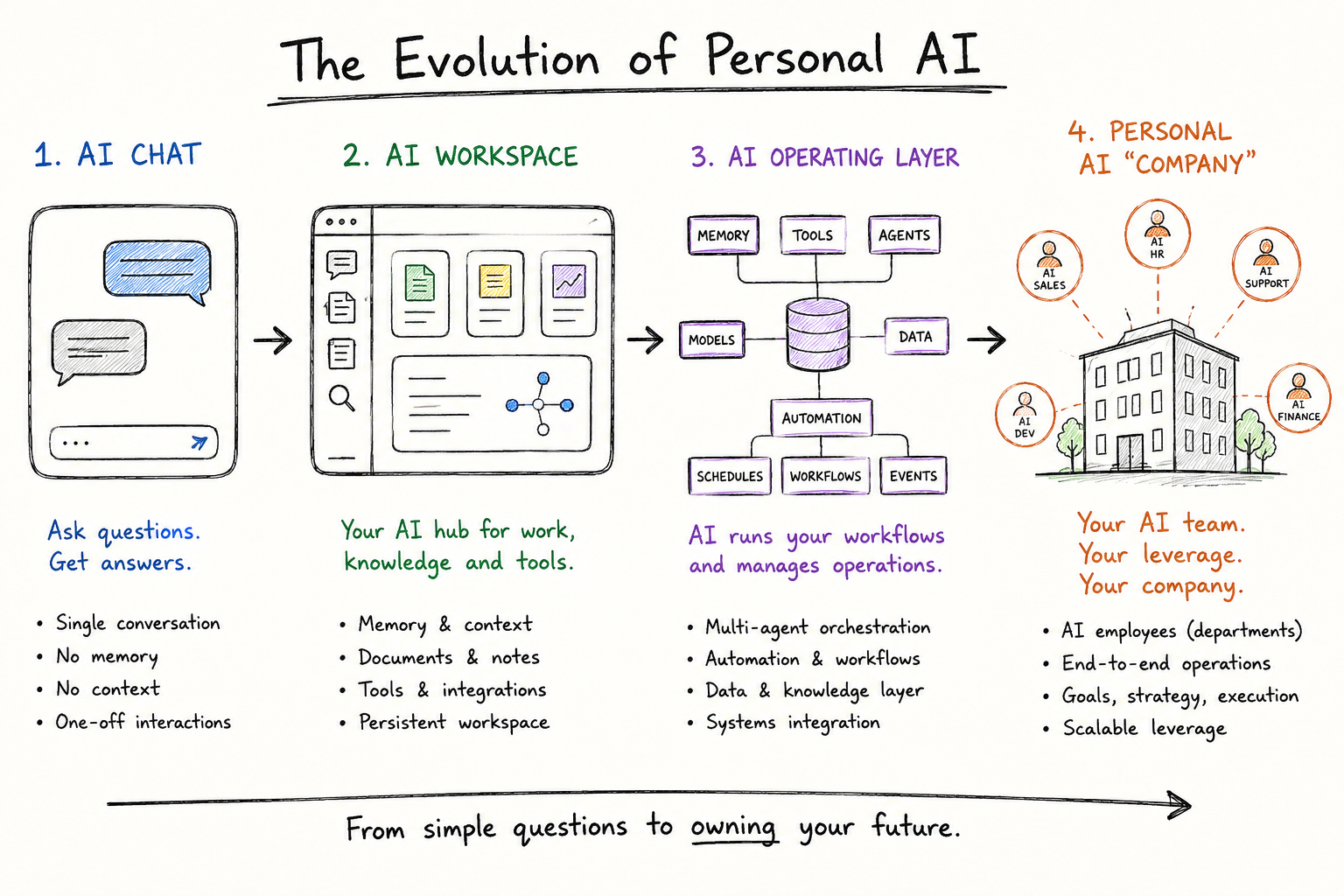
Today, Odysseus is the workspace rung the OS layer sitting above the model. Hermes is already reaching toward the operating layer, positioning itself as the operator that ties your services together.
And the frontier? It's visible in PewDiePie's own accidental multi-model "council," built weeks before Andrej Karpathy's now-famous LLM Council project, where multiple models debate, cross-check, and vote to reduce hallucination and single-model bias.
That pattern matters for a specific reason: models are demonstrably better at grading answers than generating them.
Now the honest caveat, because the hype machine will skip it:
Most people will never need a personal AI company.
For the vast majority, a private, capable ChatGPT replacement that remembers their documents is more than enough. The "AI department" vision is real and coming, but it's a power-user horizon, not a mass-market requirement.
Trends actually worth watching:
- MCP hardening (see: the quarter of servers with no auth)
- Local models continue to close the gap
- Consolidation of sprawling stacks of Open WebUI + n8n + LiteLLM + AnythingLLM collapsing into single unified workspaces
A year ago, a self-hosted AI workspace felt early.
Next year, we will be asking, "Can I run this privately with my own models and memory?" This may feel as normal as asking whether software has an API.
The Verdict: Don't Crown a Winner, Pick the Right One
There is no "best" here. These three aren't competing. They're claiming different land in a country that didn't exist two years ago.
- Choose Odysseus if you want a private, polished, all-in-one ChatGPT/Claude replacement for your own server, with chat, research, notes, documents, memory, and hardware-aware local models. It's a personal AI workspace.
- Choose Hermes if you live in a homelab and want an always-on operator that automates, monitors, and orchestrates your services from a Pi, a NAS, or a cheap VPS. It's an AI operations manager.
- Choose OpenClaw if you're an engineer who wants an autonomous, skill-driven agent that writes code, controls your machine, and reaches you across every messaging channel. It's an autonomous engineering platform. Sandbox it properly. Please.
So no, Odysseus doesn't "beat" Hermes or OpenClaw. That's the wrong frame entirely.
Odysseus is a personal AI workspace. Hermes is an agent operations console. OpenClaw is an ambient autonomous engineer.
They're sketching the same future from three directions, one where AI is no longer a website you visit, but an environment you own.
A year ago, the interesting question was "Which AI model is smartest?"
In 2026, the better question is:
"Who controls the workspace where your intelligence gets amplified?"
And the fact that a YouTuber's weekend project surfaced that question for millions of people? That might be the most remarkable twist in the whole story.
The smartest model in the world doesn't matter if you're renting it by the month and it lives on someone else's machine.
Resources:
https://odysseusai.dev
https://github.com/pewdiepie-archdaemon/odysseus
A note on certainty: this space moves weekly. Star counts, feature sets, licensing, and integration depth, especially Claude Code / Codex, are all moving targets. Verify the current specifics against each project's live repository before making a decision.