Chatbots Were Never the Endgame

The Real AI Race Is About Machines That Understand Reality
Teaser: Chatbots are expert systems powered by AI. The real race is about machines that understand how reality works. And the country currently winning it might surprise you.
TL;DR: The AI race in your feed isn't the real one. Chatbots are a sideshow. The actual competition is about machines that understand how physical reality works. And the country currently winning that race isn't the one American tech media keeps pointing at.
You've been watching the wrong race.
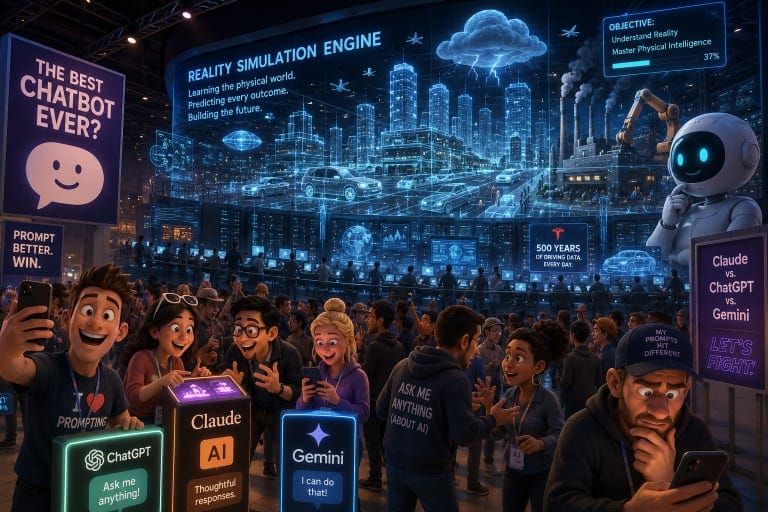
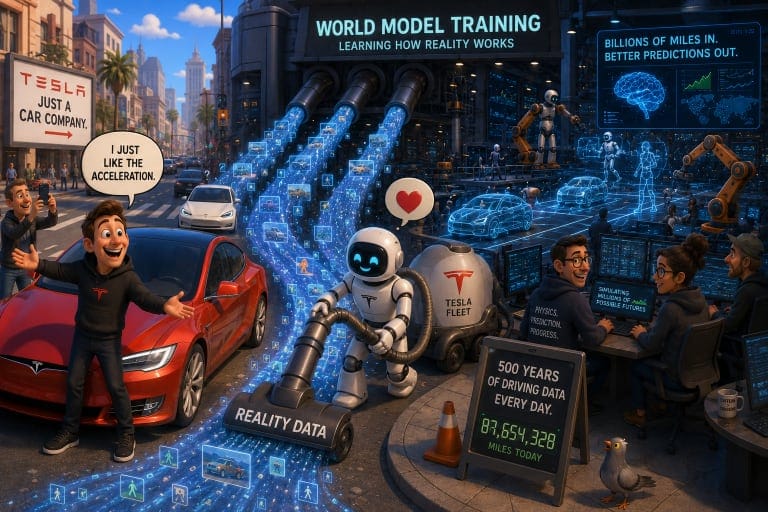
Every day, Tesla's fleet collects 500 years of driving data. Every. Single. Day. While the discourse argues about which chatbot writes the cleaner cover letter, the companies actually driving the future of AI moved on a while ago.
They stopped racing to build the world's best autocomplete. They're building something else.
Machines that understand how reality behaves.
Chatbots predict language. World models predict reality.
The distinction sounds small. It isn't.
AI Is Not a Chat Window. Sorry.
Easy mistake to make. ChatGPT arrived like a cultural thunderclap in late 2022 and reset everyone's mental model of what AI is. Suddenly, "AI" meant a chat window. Something you ask questions. Something you argue with. Something you occasionally trust with your inbox.
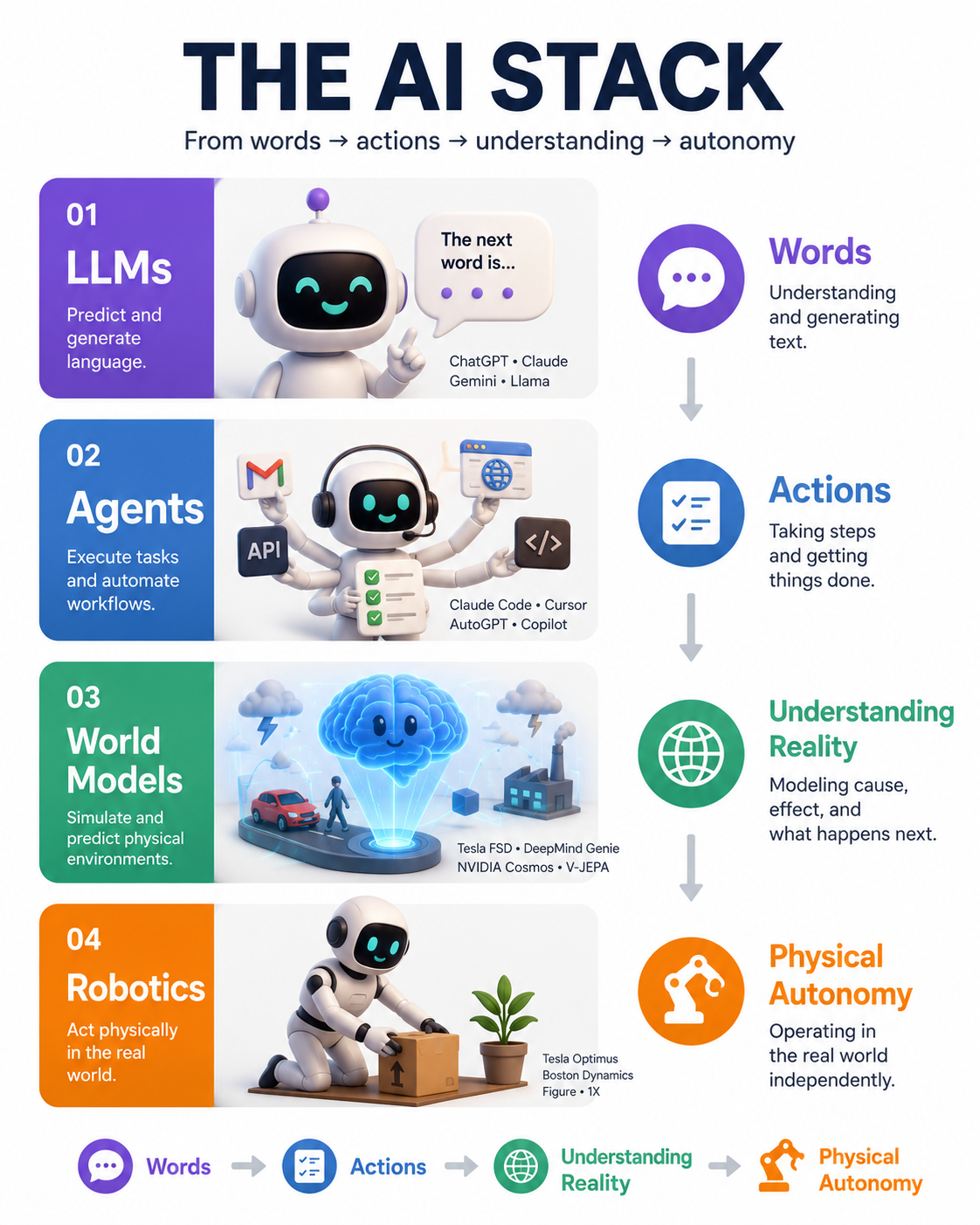
But AI is a stack of different technologies. Each solves a different problem:
- LLMs: Predict and generate language. ChatGPT, Claude, Gemini.
- Agents: Execute tasks and automate workflows. Claude Code, Cursor, AutoGPT.
- World Models: Simulate and predict physical environments. Tesla FSD, DeepMind Genie 3.
- Robotics: Act physically in the world. Tesla Optimus, Boston Dynamics.
Agents are where the confusion starts. People conflate them with "advanced AI." Translation: they're sophisticated workflow systems. They call APIs, browse the web, write code, and automate digital tasks. Useful. Powerful. Still firmly inside the world of pixels.
World models are a different species. They don't execute instructions. They simulate environments, model cause-and-effect, and predict future states.
The split matters. Agents help machines do work. World models help machines understand the world they're working in.
What's a World Model? Your Brain, For Starters.
The simplest example: your brain is running a world model right now.
You're predicting hundreds of things without thinking about it. Where the floor is relative to your feet. That a glass too close to the table edge will fall. The car in your peripheral vision is slowing, not accelerating. You don't calculate any of this consciously. Your brain built an internal simulation of how physical reality works, and it runs it continuously.
World models try to give machines the same capability. Not the ability to describe reality in words. The ability to simulate it. Space, time, motion, cause, and effect. The behavior of objects bouncing into each other.
ChatGPT predicts the next word. A world model predicts the next state of the world.
This isn't a new idea. Ha and Schmidhuber's foundational 2018 paper, "World Models," showed that agents could learn compressed representations of environment dynamics and use them for planning. What's changed is scale, compute, and the arrival of serious institutional money.
Meta's AI chief, Yann LeCun, has been making the architectural argument for a while: LLMs are pattern-matching systems over tokens. They struggle with long-term planning, causal reasoning, and persistent spatial understanding. His alternative is JEPA, Joint Embedding Predictive Architecture. The pitch: predict abstract representations of the world, not raw pixels or words. Translation: model concepts, not surface statistics. Your phone's autocomplete does surface statistics. Your brain does concepts.
The companies pushing this frontier are not playing around.
The Race Is Already Running
Google DeepMind: Genie 3. Revealed August 2025. DeepMind calls it "the first real-time interactive general-purpose world model." It generates diverse, interactive 3D environments from a text prompt. 720p. 24 frames per second. Maintains physical consistency across time. Nobody explicitly programmed it to understand how objects move and interact. The model learned that on its own. TIME named it one of 2025's best inventions.
NVIDIA: Cosmos / Cosmos-Predict2.5. Launched at CES 2025 as an open-source platform trained on 20 million hours of real-world video. By late 2025, NVIDIA had shipped Cosmos-Predict2.5, trained on 200 million curated video clips with reinforcement learning baked in. The point wasn't impressive video clips. The point was to give robots and autonomous systems a "digital twin of the world" to train on before they touch physical reality.
Meta: V-JEPA 2. Released June 2025. A 1.2-billion-parameter world model trained on over a million hours of video. The headline capability: zero-shot robot planning. V-JEPA 2 can operate a robot in an environment it has never seen before, because it has built an internal model of how physical objects behave. Reportedly, 30x faster than NVIDIA's Cosmos.
Side-by-side, the three systems shake out like this:
- Genie 3 (Google DeepMind): Interactive 3D world generation. Zero-shot. Closed. Research stage. Training scale undisclosed.
- Cosmos-Predict2.5 (NVIDIA): Digital twin for robotics and AV. Partial zero-shot. Open. Production. 200M video clips.
- V-JEPA 2 (Meta): Zero-shot robot planning. Open. Research stage. 1M+ video hours.
What these systems share is qualitatively different from that of language models. Chatbots understand descriptions of reality. World models attempt to simulate reality itself.
Aren't Multimodal LLMs Closing This Gap Already?
Fair objection. The current flagship GPT-5.5 is natively omnimodal. Gemini 2.5 supports text, images, video, and audio in a single model. Google's Project Astra is no longer a demo; its capabilities are being folded into Gemini Live right now. If LLMs keep absorbing capabilities, does the LLM-vs-world-model distinction even hold?
Sort of. But not the way the LLM-maximalists think.
There's a structural difference between reasoning about physical events described in tokens and maintaining a persistent causal model of a continuous environment. One is a very good description. The other is a simulation. As LeCun frames it: you could memorize every cookbook ever written and still have no idea what food tastes like.
The stress test is the sim-to-real gap. That's the persistent failure of AI systems trained in simulation to generalize cleanly to the real world. Friction coefficients vary in ways that simulations don't capture. Lighting shifts. Objects behave in unexpected ways. Domain randomization, system identification, and actuator modeling have made progress. The gap remains the field's most stubborn unsolved problem. It's architectural, not just a data volume issue.
LLMs don't solve it by absorbing more video. They face it for the same reason purpose-built world models do. The physical world is continuous, causal, and full of surprises. Token prediction wasn't designed to handle any of that.
Multimodal convergence is real. World models as a distinct architectural priority is also real. Both things are true at once. Anyone selling you a binary on this is selling you a binary, not a thesis.
Tesla Isn't a Car Company. It's a Reality Data Farm.
Tesla is usually discussed as an electric vehicle company. Sometimes, as a self-driving company. It probably deserves a different label entirely.
The largest reality-data collection operation in the Western world.
Here's the thing about training a world model: data is everything. Not curated data. Not synthetic data. Messy, unpredictable, real-world data. Edge cases. Near-misses. Weird weather. Chaotic intersections. The kind of moment no simulation designer would have thought to script.
As of May 2026, Tesla vehicles have driven over 10 billion miles on Full Self-Driving. The fleet adds approximately 29 million miles per day. Roughly 4 billion of those miles happened on city streets. Researchers consider city-street data exponentially more valuable than highway data. Cities are dense with unpredictable human behavior. Highways are mostly straight lines.
According to a presentation at ICCV 2025, Tesla's fleet generates the equivalent of 500 years of driving data every single day.
Read that again. Five hundred years. Every day.
Tesla also built a simulated world. A neural network that synthesizes all 8 camera feeds at once. Engineers can inject adversarial events into the sim: a pedestrian stepping into traffic, a car cutting across lanes. Then test model responses without driving a single real-world mile.
This leads directly to Optimus. Tesla's humanoid robot. Chatbots don't need physics. Robots absolutely do. Balance. Spatial reasoning. Force estimation. The ability to anticipate how an object responds when you pick it up. Tesla shifted Optimus training to a vision-only approach using video recordings of humans performing tasks. Same logic as FSD learning from human drivers. Optimus has already demonstrated zero-shot transfer: learning tasks entirely in simulation, then executing them in the physical world with no additional retraining.
Elon Musk has projected Optimus will eventually deploy in the hundreds of millions, possibly billions. File that alongside his other timeline predictions and weigh accordingly. The strategic logic is coherent. The number is a press move.
The China Problem Nobody Wants to Talk About
Here's where the thesis gets uncomfortable. And where most Western AI coverage quietly changes the subject.
If the data flywheel argument holds (more real-world data, better world models, physical autonomy dominance), then the most important question isn't which American lab has the best architecture. It's who's shipping the hardware that generates the data.
Right now, that answer is China. By an embarrassing margin.
Chinese companies shipped roughly 80% of the world's humanoid robots in 2025. Let's break it down:
- Unitree: 5,500+ units shipped
- AgiBot: 5,000+ units shipped
- Tesla: approximately 150 units
- Figure AI: approximately 150 units
- Agility Robotics: approximately 150 units
You read that correctly. The three American golden children, combined, shipped fewer humanoid robots in 2025 than Unitree did before lunch.
Morgan Stanley has doubled its delivery forecast for the Chinese humanoid robot market for 2026. They're now projecting 28,000 units. A 133% increase over 2025.
This isn't a footnote. It's a structural challenge to the central argument of every American "we're winning AI" thinkpiece written this year.
The playbook is familiar. Solar panels. Batteries. Drones. EVs. In each case, Chinese manufacturers moved faster in production, drove down costs through volume, and captured the market before Western competitors could establish a manufacturing moat. The hardware ships the data. The data trains the model. The model wins.
To be precise about Tesla: its data advantage is real, but it's narrow. Roads. The race for physical-world models eventually extends to every other environment. Factories. Homes. Hospitals. Construction sites. In those environments, the data geography looks very different from what a Tesla fleet covers.
The honest reframe: the Tesla argument is more accurately a claim about who wins the Western data flywheel race, not about global world-model dominance. Still a massive prize. Just a different, more defensible claim. The global race has a different leader, and the American tech press has been writing around that fact for two years.
Reality Engines: The Race Nobody Reported On
Zoom out. The actual competition isn't about who builds the best chatbot.
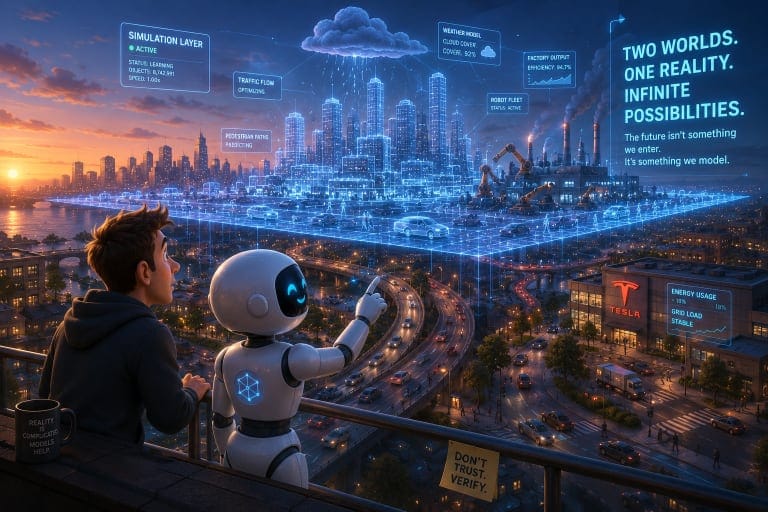
It's about who builds the most accurate simulation layer for physical reality.
This is the framing the major AI labs operate under now, even when they don't say it out loud. NVIDIA's Cosmos is explicitly designed to give robots a "digital twin of the world" to learn from before deployment. DeepMind's Genie 3 generates unlimited training environments that stay physically consistent because the model has internalized the rules of physics on its own. Meta's V-JEPA 2 is built on the premise that language is one narrow slice of intelligence. The rest requires understanding how the physical world moves and responds.
The implications go well past robotics. Digital twins are already deployed in manufacturing, logistics, and urban planning. Companies simulate outcomes before factories are built, before traffic systems are redesigned, before supply chains are reconfigured. They run the future in simulation first, then execute in reality.
The next industrial revolution may happen twice. Once in simulation. Then again, in real life.
Language Was the Demo. Reality Is the Product.
Language was the first interface between humans and AI. Natural choice. Text is abundant. Easy to collect. Captures a staggering amount of human knowledge. Language models unlocked something genuinely remarkable.
But language is a description of reality, not reality itself.
You can describe the weight of a box without knowing how to lift it. You can describe a burning building without understanding how fire spreads. You can describe a robot assembling a circuit board without being able to plan the sequence of motions.
World models are the bridge between conversational AI and physical autonomy. What follows:
- Humanoid robots in warehouses and homes
- Drones navigating dynamic environments without pre-mapped routes
- Autonomous vehicles adapting to genuinely novel conditions
- Surgical systems model tissue responses in real time
- Disaster response robots operating in unpredictable, GPS-denied terrain
What ties them together is the same underlying capability. An AI that doesn't just know facts about the world, but has internalized enough about how reality works to act inside it.
Language was the first interface. Reality is the next one.
It's 1988. Chatbots Are Expert Systems.
Step back. There's a useful historical parallel here. It isn't AOL.
The more precise analogy is the collapse of rule-based expert systems in the late 1980s. For roughly two decades, AI researchers bet heavily on hand-coded rules. If-then logic trees encoding human expertise. These systems were impressive in narrow domains. They were also fundamentally limited. Brittle in novel situations. Expensive to maintain. Unable to generalize.
The field didn't move past them by writing better rules. It moved past them by switching to statistical learning. Different architecture. Different paradigm. The rules people couldn't write explicitly, the models learned from data.
Chatbots may be in the position expert systems were in 1988. Impressive in their lane. Architecturally limited for what comes next.
The systems being quietly assembled at DeepMind, NVIDIA, Meta, Tesla, World Labs, and dozens of research labs are aimed at something fundamentally different. They're not smarter chatbots. They're not bigger text predictors. They're building AI that doesn't just know the words for things.
They're building AI that understands how things behave.
We thought the breakthrough was machines learning to talk.
History may remember the real breakthrough as the moment they learned how the world works.
Now the Slightly Uncomfortable Part
Pause here. Not for dystopian hand-wringing. For an honest question worth taking seriously.
What happens when machines become extremely good at predicting reality?
The interesting risks aren't the science fiction ones. Rogue robots. Sudden uprisings. HAL 9000. Those scenarios are distracting. The real risks are quieter. And we have historical receipts.
Boeing's Maneuvering Characteristics Augmentation System (MCAS) relied on a model rather than direct pilot feedback. 346 people died. The 2008 financial crisis was partly a story of risk models that couldn't represent what they couldn't model. The institutions trusted the outputs anyway. COVID epidemiological projections were confidently wrong in ways that shaped global policy for years.
None of those systems was malicious. They were just simulations that humans trusted past their valid range.
When simulation is fast and cheap, the temptation is to trust it completely. Run the factory in simulation before running it in reality. Simulate the surgery before you perform it. Model the policy outcome before you enact it. Often genuinely useful.
But simulations are models. They reflect the assumptions baked into their training data. They fail in ways that can be invisible until they're catastrophic.
The danger isn't AI becoming conscious. It's civilization quietly outsourcing its judgment to a simulation layer.
Here's the kicker. The sim-to-real gap is a technical problem. It will narrow over time. The sim-to-judgment gap, where humans stop interrogating model outputs and just execute them, is a cultural problem. It doesn't auto-correct.
Who Should Care, and Why
Builders, take notes:
- Robotics, manufacturing, or logistics infrastructure? World models are moving from research to production faster than most expect.
- Building AI tooling for physical environments? The architectural shift creates real platform risk for LLM-first approaches.
Investors, do the math:
- Hardware production capacity may matter as much as model architecture. The data flywheel needs physical robots running in the real world.
- Watch the China robotics IPO pipeline. Unitree, AgiBot. Leading indicator of where the data generation scale is heading.
Skeptics, here's your case:
- The sim-to-real gap is real and unsolved. Every company in this space is betting that it becomes manageable. That bet hasn't fully paid off yet.
- JEPA architectures, such as V-JEPA 2, still face challenges with model collapse. They lack the years of benchmark validation LLMs have accumulated.
Pick a side. The fence is getting crowded.
One Falsifiable Prediction
If world models are genuinely the next platform shift, not just a research trend, here's what you'd expect to see by 2028:
- At least one purpose-built world model benchmark is adopted across major labs as a standard evaluation. Think ImageNet or MMLU, but for physics.
- At least one deployed humanoid robot platform logging 1 million+ hours of cumulative real-world operational data.
- At least one Fortune 500 company is replacing a major simulation workflow (manufacturing, logistics, drug development) with a neural world model in production.
Those are the tells. Watch for them. They'll matter more than the chatbot benchmark cycle.
Three years. Three checkpoints. If none of them hit, the thesis is wrong, and you can come back and tell me so.
Receipts
World Simulation with Video Foundation Models for Physical AI - We introduce [Cosmos-Predict2.5], the latest generation of the Cosmos World Foundation Models for Ph...
Cosmos World Foundation Model Platform for Physical AI - arXiv - Physical AI needs to be trained digitally first. It needs a digital twin of itself, the policy model...
Nvidia releases its own brand of world models - Nvidia is getting into world models AI models that take inspiration from the mental models of the ...
Generative and Predictive AI for digital twin systems in manufacturing - AI-driven approaches are expected to revolutionize digital twin technology by significantly expandin...
AI's next big thing is world models - Axios - Move over large language models, the new frontier in AI is world models that can understand and sim...